
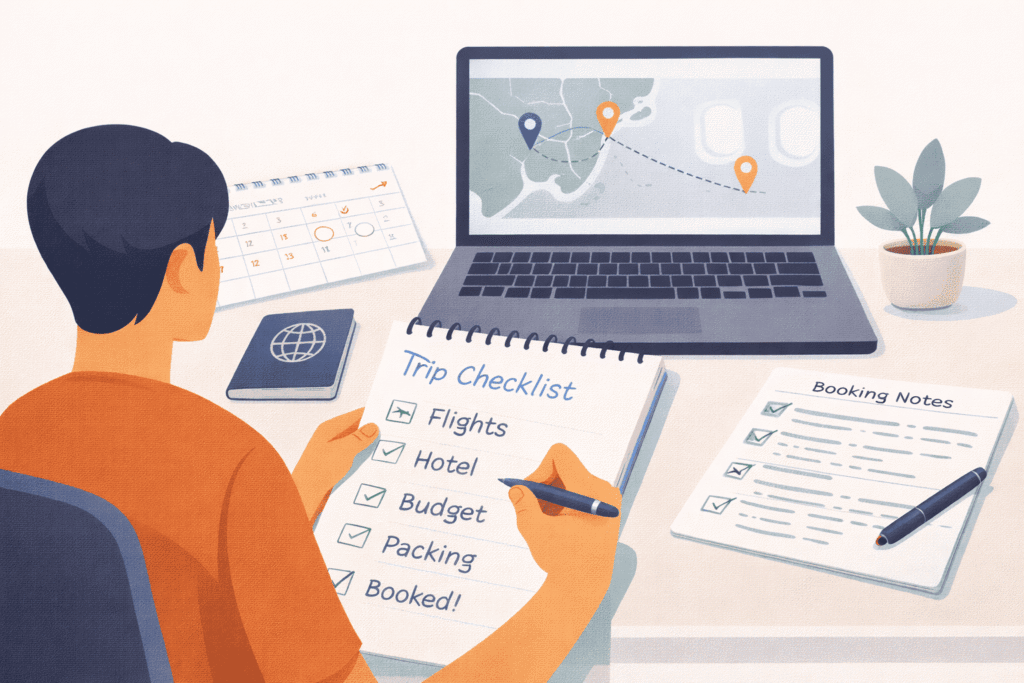
A good trip plan is not a giant spreadsheet. It is a sequence of decisions made in the right order: where to go, when to travel, what documents you need, how to book, and what could go wrong.
This trip planning checklist keeps those decisions organized from the first idea to a booked itinerary.
Quick Answer
- Best for: travelers organizing a self-planned trip; people who forget key tasks until the last minute; anyone trying to reduce booking mistakes and stress
- Worth it when: you are planning more than one booking element; you want to compare options methodically; you care about timing, logistics, and cost control
- Not worth it when: someone else is handling every booking detail; you are taking a very simple one-stop trip with almost no planning needs; you refuse to document anything at all
- What you need: your destination list, travel dates, passport or ID requirements, budget, booking deadlines, and a place to track decisions.
- Biggest gotcha: booking flights or lodging before checking documents, timing, safety basics, cancellation rules, and how the itinerary fits together.
- Next step: outline the itinerary, documents, money, flights, lodging, and ground logistics before locking in nonrefundable plans.
What a trip checklist should cover
For international trips, start with documents and destination requirements. The U.S. State Department’s International Travel Checklist recommends reviewing travel advisories, entry and visa requirements, passport validity, local laws, health information, and travel documents before departure.
For U.S. airport travel, TSA says adult passengers 18 and older need acceptable identification at the checkpoint, and its acceptable ID list can change without notice.
When it’s worth it (and when it isn’t)
Worth it if…
- you are planning more than one booking element
- you want to compare options methodically
- you care about timing, logistics, and cost control
Skip it if…
- someone else is handling every booking detail
- you are taking a very simple one-stop trip with almost no planning needs
- you refuse to document anything at all
The useful balance is structure versus flexibility. A checklist should reduce missed details without turning the trip into an overplanned schedule.
Travel booking checklist: What to confirm before you book
A travel booking checklist is most useful before money becomes difficult or expensive to recover. Before confirming flights, accommodation, transportation, or major activities, make sure the basic pieces of the trip work together. A multi-flight route such as this 10-day Brazil itinerary shows why the order matters.
Some trips have a single booking constraint that should come first. In this 10-day Peru itinerary, the Machu Picchu entry determines the train, hotel, and transfer sequence, which is why the booking order matters as much as the route itself.
- Destination and dates: confirm the trip length, season, major local events, and whether your dates are flexible.
- Documents: check passport or ID validity, entry requirements, visas, and any destination-specific rules that apply to you.
- Flights: compare the full itinerary, baggage rules, connection times, airports, and change or cancellation conditions.
- Accommodation: evaluate location, transportation access, total price, taxes, and cancellation terms rather than only the nightly rate.
- Ground transportation: decide how you will move between the airport, accommodation, and the main areas you plan to visit.
- Activities: identify which reservations are genuinely time-sensitive and which can remain flexible.
- Payments and confirmations: save booking references, payment details, cancellation deadlines, and essential contact information in one place.
Do this review before making nonrefundable bookings. The goal is not to finalize every hour of the trip, but to catch conflicts and missing information while you still have flexibility.
Step by step: How to do it
- Choose the destination. If you are still deciding where to go, use a simple framework to choose a travel destination based on trip goals, budget, timing, season, and travel friction. Then define the date window and trip length.
- Price flights before locking the rest of the trip.
- Choose a location strategy for hotels or rentals, not just the cheapest property.
- List must-do activities and book only the time-sensitive ones early.
- Track confirmation numbers in one document, note, or travel planning tool.
- Review passport, visa, payment, and transport details before the final week.
- Do a last check of timings, bags, and cancellation rules before departure.
Before booking, confirm passport or ID needs, entry rules, airport-security requirements, cancellation policies, and health or safety guidance for your route. For trips with ferries and multiple hotel changes, a route such as this 7-day Greece itinerary shows why transport timing and connection buffers should be checked before you lock in the bookings. For a road trip where weather, elevation, and park access matter just as much, use the 7-day Arizona road trip as a planning model.
Example with assumptions
This checklist example is intentionally practical; add or remove items based on destination, passport, traveler age, and trip complexity.
- Trip type: one-week city trip
- Travelers: two adults
- Bookings needed: flights, hotel, airport transport, one timed attraction
- Goal: reduce stress and avoid avoidable fees
Option A: A simple checklist keeps the travelers from booking flights first and realizing later the hotel location is impractical.
Option B: A single itinerary note prevents missed confirmations and duplicate bookings.
Conclusion: In this scenario, a checklist improves both cost control and peace of mind without making the trip feel overplanned.
Common mistakes and gotchas
- Booking flights before checking destination logistics.
- Choosing accommodation based only on nightly rate.
- Forgetting passport validity or entry rules.
- Not saving confirmation numbers in one place.
- Overbooking every hour and leaving no margin. For a practical example with rail transfers and open time, see this 10-day Spain itinerary. For a route where weather margin matters just as much as transit time, see this 10-day Argentina itinerary.
- Missing cancellation cutoffs.
FAQ
How early should I start a trip checklist?
As early as you need to make better decisions on flights, lodging, and logistics.
Do I need a spreadsheet?
Not necessarily. A note, doc, or app can work as long as everything lives in one place.
Should I book activities early?
Only the ones that are time-sensitive, limited, or central to the trip.
What is the biggest mistake in trip planning?
Letting bookings happen in the wrong order or without a central record.
Conclusion
A good trip planning checklist keeps the practical details visible while leaving room for the trip to breathe. Use it to organize documents, money, flights, lodging, safety, and timing before you lock in bookings.
- Use the checklist to catch documents, timing, money, and logistics before they become problems.
- Sequence major bookings so flights, lodging, and ground plans support each other.
- For U.S. travelers or U.S. airports, verify current State Department and TSA guidance when it applies.
Last updated: August 4, 2026. Travel documents, airport ID requirements, destination rules, prices, and cancellation policies can change; U.S. State Department and TSA guidance is especially relevant for U.S. travelers and airports.