
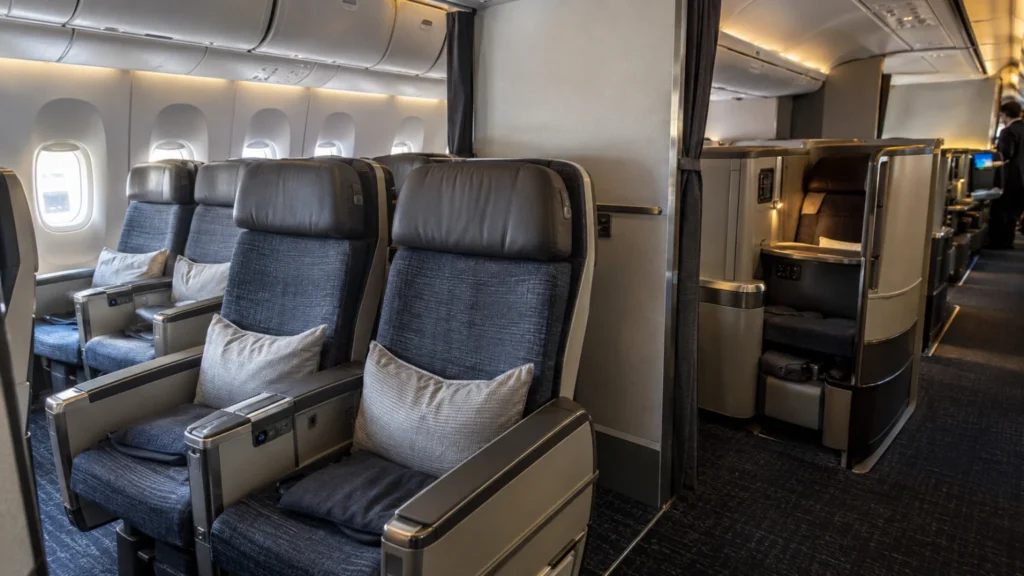
Premium economy and business class both sit above economy, but they solve different problems. Premium economy usually buys a better seat and a smaller cabin. On many long-haul aircraft, business class adds the possibility of lying flat, more privacy, and a different airport experience.
The useful business class vs premium economy comparison is not the cabin name alone. It is the exact seat, flight timing, aircraft, fare, benefits, and price for the trip you are booking.
Quick Answer
- Choose premium economy when: you want more space and comfort but do not need a bed or full premium ground experience.
- Choose business class when: sleep, privacy, aisle access, or arriving functional has enough value to justify the difference.
- Check first: exact aircraft, seat map, operating carrier, schedule, and fare benefits.
- Biggest gotcha: neither label guarantees the same product on every route.
Business class vs premium economy at a glance
| Feature | Premium economy | Business class |
|---|---|---|
| Seat | Usually a wider recliner with more legroom | Can range from a recliner to a lie-flat seat |
| Sleep | Improved posture, but usually upright | Lie-flat can materially improve overnight rest |
| Aisle access | Often shared within a pair or row | Common on newer long-haul layouts, not universal |
| Airport | May include priority services | May include lounge and broader priority benefits |
| Food and service | Enhanced economy-style service | More space, courses, and service flexibility |
| Cost | Lower cash or award step | Higher cost and opportunity cost |
The seat is the first real dividing line
Premium economy is normally a dedicated cabin with a larger recliner, more pitch, and fewer seats across than economy. Business class varies more. A short-haul business cabin may use an economy-style seat with a blocked middle, while a long-haul product may provide direct aisle access and a fully flat bed.
Check the actual business class seat and the airline’s current aircraft page. Airlines such as Qantas and British Airways publish current cabin information, but scheduled aircraft can still change.
For sleep, schedule matters almost as much as the bed
A lie-flat seat is most valuable when the flight leaves enough time to use it. On a short overnight segment, boarding, meal service, and landing preparation can leave only a narrow sleep window. On a long daytime flight, a premium-economy recliner may cover the need if you plan to stay awake.
Think about the first day after arrival. In a business class vs premium economy decision, sleep value often matters more than the cabin label itself. If poor sleep would erase an expensive day of the trip, business class has a stronger practical case. If the arrival is flexible and the premium is large, premium economy may be the better compromise.
Do not assume lounge access or flexibility
Business class often includes priority check-in, boarding, baggage, and lounge access, but fare families and airports can change those benefits. Premium economy may include selected priority services without lounge access. Read the fare conditions for the exact ticket instead of valuing a generic benefits list.
A five-question decision test
- Is the business seat fully flat on the scheduled aircraft?
- How many realistic hours could you sleep?
- Would the arrival condition change the trip?
- What is the total cash or points difference, including fees?
- What else could those points or dollars fund?
If business class solves a real sleep or mobility problem and the premium is comfortable, it may be worth it. If the flight is daytime, the premium-economy seat is strong, and the upgrade would consume another trip’s budget, keep the cheaper cabin. The broader business class value guide helps frame that opportunity cost.
Cash, points, and upgrades
Compare all three cabins on the same flights, then calculate the incremental price from economy to premium economy and from premium economy to business. For awards, compare taxes, cancellation rules, and transfer risk as well as points. Do not transfer flexible points until the exact seat is available and bookable. If you are new to premium awards, start with the guide to booking business class with points.
An upgrade offer deserves the same test. Confirm what the upgraded fare includes, whether the offer is refundable, and whether other passengers on the booking are covered.
Common mistakes
- Assuming every business seat lies flat.
- Comparing cabin names without checking the operating carrier.
- Paying for a bed on a flight with little usable sleep time.
- Assuming every business fare includes a lounge.
- Ignoring aircraft changes after booking.
Related Reading
FAQ
Is premium economy closer to economy or business class?
The seat is usually closer to an improved economy recliner than a long-haul business bed. The exact space and service still vary by airline and aircraft.
Is business class always worth it overnight?
No. The seat must be suitable for sleep, the schedule must leave enough time, and the premium must make sense for your budget or points balance.
Conclusion
The right business class vs premium economy choice depends on the exact flight. Premium economy is often the rational comfort upgrade, while business class becomes more compelling when a real bed, privacy, and a better arrival materially change the trip. Compare the aircraft, schedule, fare, and opportunity cost instead of relying on the cabin label.
Last updated: September 2026. Aircraft, cabins, seats, lounge access, fare benefits, schedules, award prices, and upgrade rules can change. Verify the operating carrier and exact product before booking.