
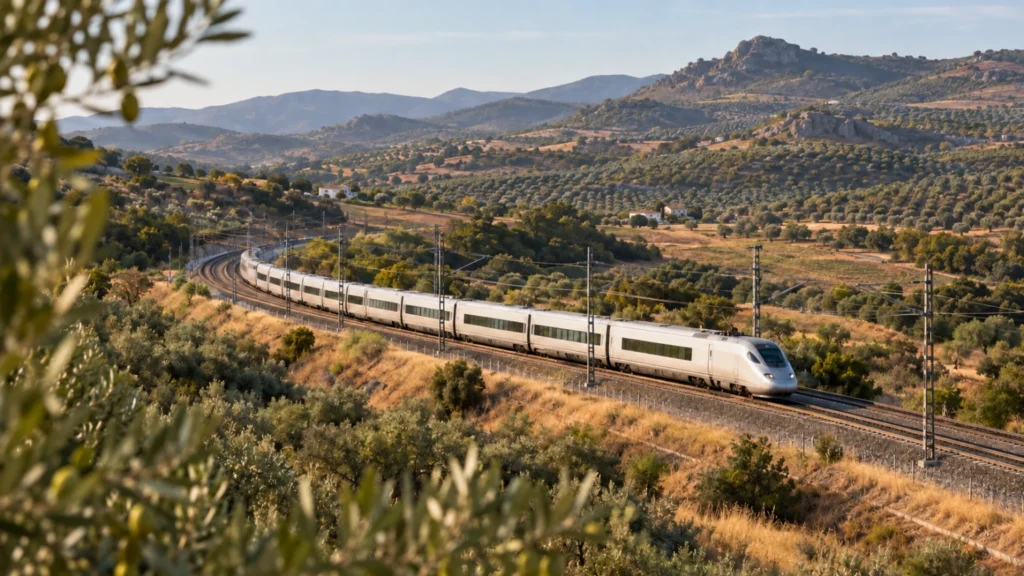
Three Spanish cities fit into ten days, but only if the route treats train days as part of the itinerary. This 10-day Spain itinerary uses nine nights: three in Madrid, three in Seville, and three in Barcelona. It avoids a fourth base and leaves room for one optional day trip.
The cleanest flight pattern is open jaw: arrive in Madrid and depart from Barcelona. High-speed rail connects the route, and a car would create more parking and city-driving work than value.
Quick Answer
- Trip definition: ten calendar days, nine nights.
- Night split: Madrid 3, Seville 3, Barcelona 3.
- Best flight pattern: into Madrid (MAD), out of Barcelona (BCN).
- Best day trip: Córdoba from Seville or Toledo from Madrid, not both.
- Car needed: no.
- Biggest trade-off: Seville to Barcelona is the longest transfer; choose a direct train when the date and schedule fit.
10-day Spain itinerary at a glance
| Day | Plan | Sleep |
|---|---|---|
| 1 | Arrive Madrid; easy central walk | Madrid |
| 2 | Historic Madrid and major museum | Madrid |
| 3 | Madrid depth or Toledo | Madrid |
| 4 | Train to Seville; Santa Cruz orientation | Seville |
| 5 | Seville cathedral, Alcázar area, and river | Seville |
| 6 | Seville depth or Córdoba | Seville |
| 7 | Direct train to Barcelona | Barcelona |
| 8 | Modernist Barcelona | Barcelona |
| 9 | Old city, Montjuïc, or coast | Barcelona |
| 10 | Depart Barcelona | — |
Days 1–3: Madrid with one optional day trip
Day 1 should absorb the flight, airport transfer, check-in, and jet lag. Choose a hotel with a straightforward link to the center and to Madrid-Puerta de Atocha if the southbound train is important. A compact evening around one central district is enough.
Use Day 2 for Madrid itself. Pair one major museum with Retiro or the historic center rather than stacking several large collections. Timed tickets can help, but a full museum plus the Royal Palace area and a late cross-city reservation creates a schedule that looks better on paper than it feels.
Day 3 is the first choice point. Stay in Madrid for markets, neighborhoods, another museum, and a slower evening, or take a Toledo day trip. Toledo makes sense when medieval architecture is a priority. It does not need to be added merely because trains exist.
Day 4: Madrid to Seville by high-speed train
Madrid and Seville are linked by high-speed services. Check Renfe, Iryo, and OUIGO España for the date you need, then compare the whole ticket: station, departure time, luggage allowance, change rules, and seat conditions. Do not choose from headline price alone.
A morning or late-morning departure leaves a usable Seville afternoon. Madrid-Puerta de Atocha and Sevilla-Santa Justa are the stations to plan around, but verify the ticket because station names and service details matter. After checking in, keep the first Seville walk close to the center.
Days 5–6: Seville, with Córdoba as the alternative
Give Day 5 to Seville’s core. The cathedral and Real Alcázar are major visits, not quick checkboxes, and current entry rules should be verified with the official sites. Add Santa Cruz, the river, or Plaza de España according to pace and weather.
On Day 6, choose between a second Seville day and Córdoba. Córdoba is the more efficient excursion for this route because it sits on the high-speed corridor north of Seville and offers a distinct architectural reason to go. It still consumes a full day once station transfers, waiting, and sightseeing are counted.
Do not schedule both Toledo and Córdoba unless day trips are the main purpose of the journey. Keeping one of those days in its base city produces a better balance.
Day 7: Seville to Barcelona without an airport day
This is the route’s longest transfer. OUIGO has published a direct Seville–Barcelona service of roughly five and a half hours with intermediate stops, while other operators or dates may offer different patterns. Search the exact travel date. A direct train avoids airport transfers and a flight-security sequence, but it still uses most of the middle of the day.
Bring food or confirm onboard options, keep luggage within the operator’s allowance, and do not book an important Barcelona attraction shortly after scheduled arrival. A hotel with a simple connection from Barcelona-Sants reduces friction.
Days 8–9: Barcelona in two geographic layers
Use one day for Modernist Barcelona. Sagrada Família and another Gaudí site can work together when timed entries and transit align, but several headline buildings in one day can feel like a reservation relay.
Use the other day for the old city, Montjuïc, or the waterfront. Pick two compatible areas rather than crossing the city repeatedly. Barcelona’s strongest final day may be the one with fewer tickets and more room to adjust for weather and energy.
Day 10: Depart Barcelona
Treat the final day as a departure day unless the flight is late. Confirm the airport terminal, transport status, bag-drop deadline, and security guidance. If flights require a return to Madrid, travel back on Day 9 rather than trusting a long same-day rail connection before an international departure.
Train booking, luggage, and operator choices
- Compare Renfe, Iryo, and OUIGO where each operates; routes and schedules vary.
- Read luggage dimensions and allowances before buying a low fare.
- Check change and cancellation terms, not only journey time.
- Arrive with enough station time to find the platform and complete any operator-specific process.
- Keep critical medication and documents in a small personal bag.
- Choose lodging for station access and the neighborhoods you will actually visit.
A rail timetable never shows the entire move. The Europe itinerary guide explains door-to-door transfer math, while the trip planning checklist helps sequence flights, hotels, and reservations.
What not to add
Granada is the hardest cut, but it is still the right cut for this version. Adding it creates a fourth base and another transfer while shrinking at least two major cities. Valencia, Málaga, and the Costa del Sol have the same problem. Build a different ten-day route around those priorities rather than attaching them to this one.
Book the route before the attraction grid
Secure the open-jaw flights first, then the three hotels, then the two intercity trains. That order protects the route. Attraction tickets belong later because their value depends on knowing which mornings and afternoons are truly available after arrival, checkout, and station transfers. Peru has a different first constraint: in this 10-day Peru itinerary, the Machu Picchu entry should be secured before the train and other nonrefundable pieces.
For Madrid and Barcelona, avoid placing a high-priority timed entry on the same afternoon as an intercity arrival. In Seville, check the current cathedral and Alcázar entry procedures before assigning times. If Córdoba or Toledo becomes the chosen day trip, confirm transport before filling the surrounding evening with another reservation.
The nine-night split is even, but the usable time is not. Madrid receives an international arrival, Seville receives a shorter train arrival, and Barcelona receives the longest transfer plus the departure morning. Protecting two full Barcelona days is why the direct train belongs on Day 7 rather than Day 8.
Travelers with limited mobility should check step-free station routes, hotel access, and attraction entrances directly. Historic centers contain slopes, cobbles, and older buildings where a map’s short distance can still require extra time. A central hotel is useful only if its actual entrance and transit links suit the traveler.
Price the route as an open jaw using the Europe gateway method. The comparison of one-way, round-trip, and open-jaw flights helps reveal whether a higher airfare prevents a costly backtrack.
Related Reading
- How to Build a 7–10 Day Europe Itinerary
- 10-Day Italy Itinerary
- Trip Planning Checklist
- Cheap Flights to Europe
- One-Way vs Round-Trip Flights
FAQ
Is ten days enough for Madrid, Seville, and Barcelona?
Yes. Nine nights split evenly gives each city two full or nearly full days plus arrival or transfer time.
Which city order is best?
Madrid–Seville–Barcelona works well with flights into Madrid and out of Barcelona. Reverse it when airfare or event dates favor the opposite direction.
Should I choose Córdoba or Toledo?
Choose Córdoba for Islamic and later Christian architecture from Seville; choose Toledo for a compact historic city from Madrid. Keep the other day in its base city.
Do I need a rental car?
No. High-speed rail and city transit fit this itinerary better than driving and parking.
Conclusion
A workable 10-day Spain itinerary needs three bases, not four. Madrid, Seville, and Barcelona each receive three nights, while one optional day trip supplies variety without another hotel move. Accept the longer Seville–Barcelona train, use an open-jaw flight, and leave Granada for a route built around Andalusia.
Last updated: September 2026. Transportation schedules, opening hours, reservations, and travel requirements can change. Verify current details before booking.