
A 10-day Italy itinerary gets much better when it stops trying to include every famous place. Rome, Florence, and Venice already fill the trip. Add too much more and the vacation becomes a sequence of train platforms, hotel lobbies, and timed reservations.
This route uses ten calendar days, with Day 1 as arrival day and Day 10 as departure day. That means you are planning nine nights on the ground, not ten full sightseeing days. A balanced split is four nights in Rome, three nights in Florence, and two nights in Venice, connected by high-speed train.
The goal is not to see everything in Italy. It is to make a first Italy trip work without rushing three major cities that reward more than a quick stop.
Quick Answer
- Suggested route: Rome for 4 nights, Florence for 3 nights, Venice for 2 nights.
- Best order: fly into Rome and out of Venice, or reverse the route if flights work better.
- Best transport: high-speed train between the cities; a rental car is unnecessary for this core itinerary.
- Biggest trade-off: skipping Amalfi, Cinque Terre, and Lake Como keeps the trip balanced.
- When to add a day trip: from Florence if the core city time still feels comfortable.
- Next step: price open-jaw flights, then check current train schedules before locking hotels.
Why This 10-Day Italy Itinerary Works
These three cities line up naturally by rail. Rome sits at one end of the classic route, Florence works as the middle base, and Venice makes a logical northern finish. Using an open-jaw flight can avoid backtracking and protect the last day from an unnecessary return train.
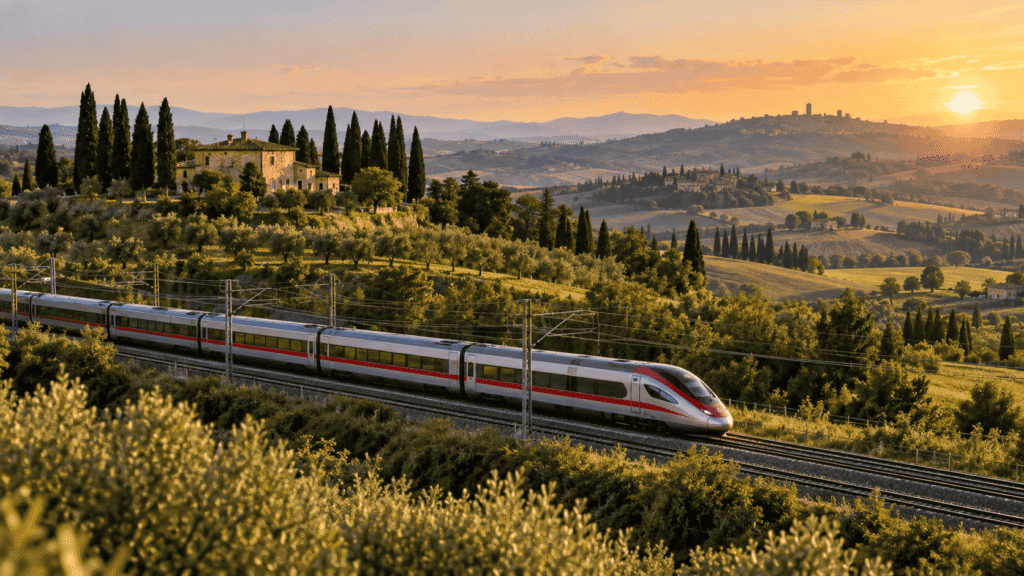
Both Trenitalia and Italo operate high-speed services on this corridor. Trenitalia describes Rome–Florence as just over 1.5 hours, while Italo lists Rome–Florence at about 1 hour 25 minutes. Italo also lists Florence–Venice at about 2 hours 15 minutes. Actual schedules vary by date and service, so check current options before booking.
The Nights Split
| Base | Nights | Why this works |
|---|---|---|
| Rome | 4 | Arrival recovery plus enough time for ancient Rome, the Vatican area, and the historic center |
| Florence | 3 | Renaissance core, museums, neighborhoods, and one possible Tuscany day trip |
| Venice | 2 | Enough time to sleep in Venice proper and experience the city beyond a day visit |
The split is intentionally restrained. Rome gets the most nights because the arrival day is rarely a full sightseeing day and the city rewards time. Florence gets three nights because it works both as a city base and a possible day-trip base. Venice gets two nights because one night is rushed, while a third night would require reducing Rome or Florence within this ten-day structure.
Day-by-Day Itinerary
Day 1: Arrive in Rome
Keep the first day light. Land, get into the city, check in or store bags, and take an orientation walk if energy allows. Do not build the day around a major timed attraction.
Day 2: Ancient Rome
Use this day for the Colosseum, Roman Forum, Palatine Hill, and the nearby historic center. Keep the evening flexible instead of stacking another major museum onto an already full day.
Day 3: Vatican Area and Trastevere
Group the Vatican Museums, St. Peter’s area, and a slower evening in Trastevere or the historic center. Check current reservation requirements and opening information before choosing exact times.
Day 4: Rome Buffer Day
This is the day that makes the itinerary breathe. Use it for the Borghese Gallery, Appian Way, Testaccio, a food-focused neighborhood plan, or anything missed earlier. A buffer day can add more to the trip than another hotel change.
Day 5: Train to Florence
Choose a train time that leaves room for checkout, luggage, and station access without rushing. After arrival, focus on Florence’s compact historic center, the Duomo area, Piazza della Signoria, and an easy first evening.
Day 6: Florence Art and City Core
Use this day for the Uffizi, Accademia, Duomo complex, or a carefully chosen combination. Avoid booking every major museum back to back unless art museums are the central purpose of the trip.
Day 7: Florence or Tuscany Day Trip
This is the optional day-trip slot. Siena, Lucca, Pisa, or a countryside day can work, but staying in Florence is also a valid choice. Add the day trip only if it improves the trip more than a slower final Florence day.
Day 8: Train to Venice
Travel to Venice and stay in Venice proper if budget and logistics allow. Use the first afternoon to get oriented: take a vaporetto, explore quieter canals, and avoid planning a tightly timed attraction immediately after the transfer.
Day 9: Venice
Use the full day for St. Mark’s area, Doge’s Palace if desired, Rialto, Dorsoduro, Cannaregio, or a lagoon-island plan. Early and later hours can also provide a very different experience from the busiest middle part of the day.
Day 10: Depart Venice
Choose flights and airport transfers that match your comfort level. If departure is very early, prioritize a practical transfer plan over squeezing another activity into the final evening.
When to Add or Remove a Stop
Add a fourth base only if you are comfortable making the trip faster. Cinque Terre, the Amalfi Coast, Milan, Lake Como, Naples, and the Dolomites all deserve time. In a ten-day first trip, adding one usually means reducing depth in Rome, Florence, or Venice.
If coastline is the priority, consider designing a different Italy itinerary rather than turning this route into a checklist. If you want fewer hotel changes, reduce the trip to two bases and use selected day trips instead.
Common Mistakes
- Treating arrival day as a full sightseeing day.
- Adding Amalfi or Cinque Terre without counting transfer time.
- Booking a round trip to Rome and then losing time backtracking.
- Changing hotels for a day trip that could be done from an existing base.
- Ignoring timed-entry reservation requirements for major attractions.
- Overpacking luggage for train transfers and Venice’s bridges and walkways.
Related Reading
- How to Build a 7-10 Day Europe Itinerary
- Trip Planning Checklist
- Google Flights Tips
- Cheap Flights to Europe
FAQ
Is 10 days enough for Italy?
Yes, if you choose a focused route. Ten calendar days is enough for Rome, Florence, and Venice at a balanced pace. It is not enough to cover every major Italian region well.
Should I visit Rome or Venice first?
Either direction can work. Rome to Florence to Venice follows a simple south-to-north sequence and can pair well with flying into Rome and out of Venice. Reverse it if fares or schedules are better.
Do I need a car for this Italy itinerary?
No. Rome, Florence, and Venice are well connected by high-speed rail for this route. A car adds parking, restricted-zone, and luggage complexity without solving the main transfers.
Can I add Cinque Terre in 10 days?
You can, but it makes the trip faster. For a first visit, adding Cinque Terre usually means reducing time in one of the three core cities or accepting another transfer and hotel change.
Conclusion
A strong 10 day Italy itinerary is not the one with the most pins. It is the route that gives Rome, Florence, and Venice enough time to feel distinct. Use the high-speed rail corridor, consider open-jaw flights, and resist adding a fourth base unless you clearly prefer speed over depth.
Last updated: September 2026. Transportation schedules, attraction rules, reservation windows, opening hours, strikes, fees, and travel requirements can change. Verify current details before booking.