
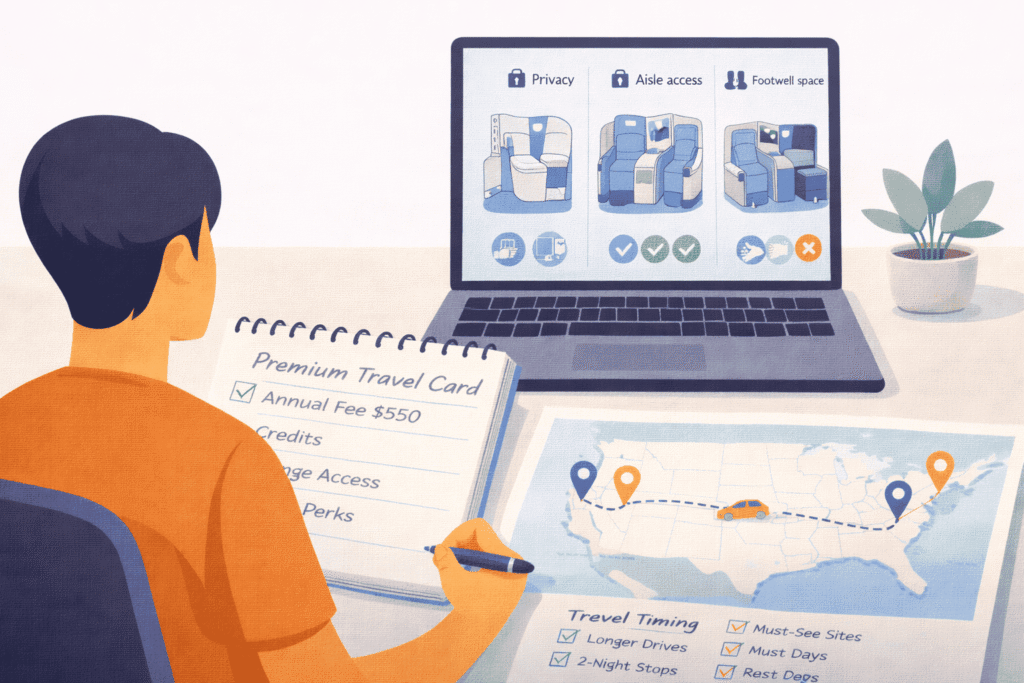
A business class ticket does not guarantee the same seat experience on every route or aircraft. Finding the best business class seats means looking beyond the cabin name and checking the actual seat, layout, aircraft, and location inside the cabin. That product difference also matters when comparing business class vs premium economy, because the value gap depends on the exact seat offered on the flight.
This guide focuses on the features that matter before you book: aisle access, sleeping space, privacy, storage, footwell design, seat location, and whether the product fits the kind of flight you are taking.
Quick Answer
- Check first: the exact aircraft and current seat map for your flight.
- For overnight flights: sleeping space, bed shape, privacy, and aisle access usually deserve more attention.
- For daytime flights: workspace, storage, window access, and schedule may matter just as much.
- Best seat location: depends on whether you prioritize privacy, views, quiet, proximity to the aisle, or traveling with someone.
- Biggest gotcha: assuming the same airline always uses the same business class product.
- Next step: compare the aircraft-specific seat map before paying more or transferring points.
Why the aircraft matters so much
Business class is a cabin category, not one universal seat design. The same airline can operate different aircraft with different layouts, seat dimensions, privacy features, and cabin configurations.
Qatar Airways states directly that its Business Class cabin and seat depend on the aircraft type, and that Qsuite is available only on select routes. See Qatar Airways’ current Business Class information.
That is why the flight number and airline name are not enough. Before booking, identify the scheduled aircraft and inspect the airline’s current seat map or product page when one is available.
What makes a business class seat better?
There is no single feature that makes one seat best for every traveler. A more useful approach is to compare several parts of the hard product.
Direct aisle access
Direct aisle access means you can reach the aisle without stepping over another passenger. It can be especially useful on overnight flights or when you expect to move around frequently.
For example, British Airways describes its Club Suite as providing direct aisle access from every seat, along with a privacy door and fully flat bed. See the current British Airways Club World product information.
Bed and footwell design
A lie-flat label does not tell you everything about sleeping comfort. Look at the usable bed shape, how much room your feet have, whether the seat narrows significantly, and whether your preferred sleeping position works with the layout.
Privacy
Privacy can come from the seat angle, shell height, dividers, staggered positioning, or a closing door. A door can be useful, but it should not automatically outweigh bed comfort, seat width, storage, or a better schedule.
Delta, for example, says the Delta One suite with full-height doors and privacy dividers is offered on most Airbus A350 and A330-900 flights. That is another reason to confirm the actual aircraft rather than relying only on the cabin name. Review Delta’s current Delta One information.
Storage and workspace
Storage matters more than it may seem on a long flight. Check whether the seat gives you practical places for a phone, headphones, glasses, laptop, water bottle, and small personal items without forcing you to keep everything in the overhead bin.
How to choose the best seat before booking
- Identify the exact aircraft. Check the scheduled aircraft for the flight rather than comparing only the airline and route.
- Open the aircraft-specific seat map. Use the airline’s own seat map when possible.
- Check aisle access. Determine whether every seat has direct access or whether some passengers must pass another seat.
- Inspect the sleeping space. Look beyond “lie-flat” and consider the footwell, bed shape, and usable space.
- Compare privacy. Check seat angle, partitions, doors, and how exposed the seat is to the aisle.
- Check the row location. Note nearby galleys, lavatories, bassinets, cabin entrances, and high-traffic areas.
- Consider your travel companion. A highly private seat may be excellent for a solo traveler but less convenient for two people who want to talk during the flight.
- Recheck before departure. If your flight details or aircraft assignment change, review the seat map again.
United, for example, publishes aircraft-specific seat maps for its fleet. Its Boeing 777-300ER page shows the cabin layout and Polaris business class configuration for that aircraft. See an example of an official aircraft seat map from United.
Window, center, front, or back?
Window seats
A window seat can offer more visual privacy and a view, but the exact experience depends on how close the seat is to the window and how the layout alternates between rows.
Center seats
Center seats can work well for couples on layouts designed for shared travel. On other aircraft, privacy dividers may make the center seats almost as separate as two solo seats.
Front of the cabin
Front rows can make boarding or leaving the aircraft more convenient, but proximity to a galley or cabin entrance can also mean more movement nearby.
Back of the cabin
Rear rows may feel farther from the main boarding activity, but some aircraft place lavatories or galleys near the back. Use the actual seat map instead of relying on a universal front-versus-back rule.
Example with assumptions
This example is illustrative. It shows why the “best” business class seat depends on the trip rather than one universal ranking.
- Route: overnight transatlantic flight.
- Option A: 1-2-1 layout with direct aisle access and stronger privacy.
- Option B: older 2-2-2 layout requiring some passengers to cross another seat to reach the aisle.
- Traveler goal: maximize sleep and minimize interruptions.
Option A is likely to fit this traveler’s priorities better because aisle access and privacy directly support the goal of sleeping with fewer interruptions.
Option B could still be the more practical choice if it has a substantially better schedule, lower price, or award availability that works for the trip.
The lesson is not that every 1-2-1 product automatically beats every 2-2-2 product. The useful comparison is whether the seat’s strengths matter enough to justify the trade-offs for that specific flight.
Common mistakes and gotchas
- Assuming an airline’s newest or most advertised product operates every business class flight.
- Comparing cabin names without checking the aircraft.
- Assuming direct aisle access automatically guarantees a comfortable bed.
- Ignoring footwell shape, storage, or seat width because the seat has a privacy door.
- Choosing a row without checking nearby galleys or lavatories.
- Paying a large premium for a marginal seat improvement on a short flight.
- Failing to recheck the aircraft and seat map after a schedule or flight change.
Related reading
- Is Business Class Worth It? — decide whether the cabin itself is worth the extra cash or points before comparing individual seats.
- How to Book Business Class with Points — understand the award-booking process once you know which products you would accept.
- Award Flight Search 101 — find award space without confusing availability with seat quality.
FAQ
What should I look for in the best business class seats?
Start with the exact aircraft and compare aisle access, sleeping space, privacy, storage, footwell design, and seat location. The best combination depends on your flight and priorities.
Is direct aisle access always better?
It is a useful feature, especially on overnight flights, but not the only one that matters. A seat can have direct aisle access and still have a restrictive footwell, limited storage, or a layout that does not suit you.
Is a window seat always the best business class seat?
No. Window seats can offer more privacy, but some layouts place certain window seats closer to the aisle or give different rows different amounts of space.
Can the business class seat change after I book?
The aircraft assigned to a flight can change, which can change the seat map or product. Recheck your reservation and seat map if the airline changes the flight details or aircraft.
Conclusion
The best business class seats are the ones that match the flight you are actually taking and the features you value most.
- Verify the exact aircraft before comparing seats.
- Evaluate aisle access, sleeping space, privacy, storage, and seat location together.
- Use airline seat maps and current product information instead of relying only on the cabin name.
- Do not pay more just because one seat has a more impressive marketing label.
Last updated: August 11, 2026. Aircraft assignments, cabin layouts, seat features, schedules, and onboard products can change. Verify the current aircraft and seat map with the airline before booking or selecting a seat.