
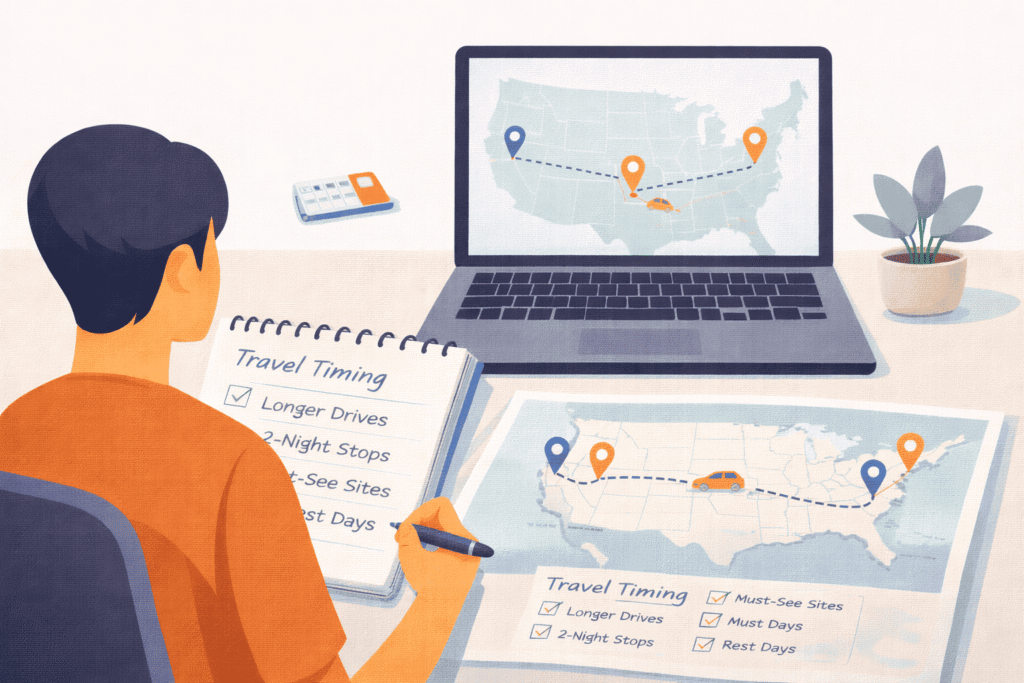
A USA road trip works best when the driving plan is realistic. Long distances can look manageable on a map, then become tiring once fuel stops, meals, weather, traffic, and daylight are part of the day. A coastal example is this 7-day California itinerary from San Francisco to Los Angeles, while the 7-day Arizona road trip shows how weather, elevation, and park access can change the same planning equation.
This guide explains USA road trip itinerary planning with a focus on routes, stops, timing, safety checks, and how much driving is actually enjoyable. If you are still organizing the wider trip, use our Trip Planning Checklist as a companion.
Quick Answer
- Best for: travelers planning a multi-stop domestic trip; families or couples choosing between scenic and fast routes; people who want realistic daily drive limits.
- Worth it when: you want the route itself to be part of the trip; you are balancing attractions with drive time; you need to reduce stress, fatigue, and wasted backtracking.
- Not worth it when: you only care about the endpoint and not the route; you are comfortable driving very long days every day; you will improvise everything and accept the trade-offs.
- What you need: a route map, daily drive limits, vehicle checks, weather awareness, stop priorities, and backup time for delays or detours.
- Biggest gotcha: building the route from map distance alone and ignoring fatigue, road conditions, vehicle readiness, and time at stops.
- Next step: sketch the route, set realistic daily mileage, choose anchor stops, and leave enough slack for weather and road conditions.
What to plan before the route looks final
Plan the car as carefully as the itinerary. NHTSA’s road trip and summer driving tips recommend checking tires, belts, hoses, recalls, route, weather, traffic, and emergency supplies before a long drive.
That checklist matters because a road trip is not just a series of destinations. It is also a vehicle, a route, a weather pattern, and a daily energy limit. The same need for weather margin appears in this 10-day Argentina itinerary, where Patagonia conditions shape the route and timing.
When it’s worth it (and when it isn’t)
Worth it if…
- you want the route itself to be part of the trip
- you are balancing attractions with drive time
- you need to reduce stress, fatigue, and wasted backtracking
Skip it if…
- you only care about the endpoint and not the route
- you are comfortable driving very long days every day
- you will improvise everything and accept the trade-offs
The useful balance is distance versus experience. A road trip works better when the route leaves enough time for stops, weather, fatigue, and changes of plan. That trade-off is especially clear in this 7-day Florida itinerary, where Miami, the Keys, and Orlando require different pacing choices.
Step by step: How to do it
- Start with total days available, then subtract arrival and departure constraints.
- Choose the route style: scenic, efficient, or mixed.
- Set a realistic daily driving target based on your group and goals.
- Cluster stops so each overnight base supports the next day well.
- Book critical overnight stays in popular areas before the rest.
- Check fuel, parking, and park-entry logistics where relevant.
- Build in one lighter day or weather backup if the route is long.
Before leaving, check road conditions, weather, vehicle maintenance, lodging cancellation rules, park or attraction hours, and safety guidance for the route.
Example with assumptions
This road trip example is about pacing and safety; adjust the mileage and stops for your vehicle, season, and driving style.
- Trip type: western USA loop
- Length: 8 days
- Travelers: two adults
- Goal: scenic stops without exhausting daily drives
Option A: A shorter loop with meaningful stops may be better than a wider route that turns every day into a recovery day.
Option B: Using two or three strategic bases can reduce constant packing without losing variety.
Conclusion: In this scenario, a strong road trip is defined less by mileage bragging rights and more by how usable each day feels.
Common mistakes and gotchas
- Planning drive days that are too long for the group.
- Ignoring parking, national park timing, or hotel availability.
- Trying to cram too many scenic detours into one day.
- Booking every night far apart and creating constant fatigue.
- Not leaving a buffer for weather or traffic.
- Forgetting that check-in/check-out timing affects the route.
Related reading
- Trip Planning Checklist — organize transportation, lodging, documents, timing, and backup plans before locking the route.
- Google Flights Tips — useful when the road trip starts or ends with a flight and you need to compare gateway airports and travel dates.
- Europe Itinerary Planning — see another example of balancing bases, travel time, stops, and itinerary pacing on a multi-stop trip.
FAQ
How many hours should I drive per day?
It depends on the group and goal, but realism matters more than ambition.
Should I book hotels in advance?
For popular regions or peak dates, yes. For flexible shoulder-season trips, you may keep some freedom.
Is a loop better than point-to-point?
Often yes, because it can simplify rental logistics and reduce one-way costs.
What is the biggest road trip planning mistake?
Underestimating how tiring repeated long drive days become.
Conclusion
A USA road trip itinerary should be planned around real driving days, not just map distance. Build the route with stops, weather, vehicle readiness, and recovery time in mind.
- Plan around realistic driving days, not only the fastest map estimate.
- Build in stops, weather checks, vehicle preparation, and recovery time.
- Use NHTSA guidance as a U.S. road-safety reference, especially for vehicle readiness.
Last updated: August 11, 2026. Road conditions, weather, vehicle safety guidance, park hours, lodging policies, fuel costs, and route timing can change; NHTSA is a U.S. road-safety reference.