
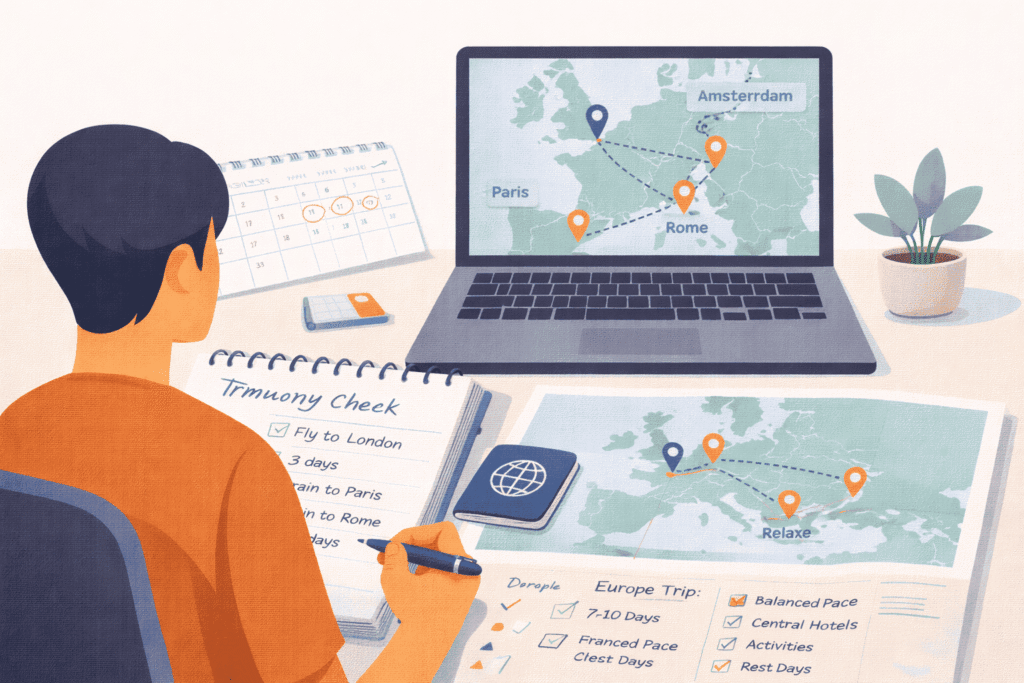
A rushed Europe itinerary can look efficient on paper and feel exhausting on the ground. With 7 to 10 days, the challenge is usually not finding enough places to visit. It is deciding how many stops still leave enough time to experience them.
This guide explains how to plan a Europe itinerary with realistic transit time, fewer unnecessary hotel changes, and enough flexibility for the trip to breathe.
Quick Answer
- Best for: travelers planning a first or relatively short Europe trip; people who tend to overpack itineraries; couples, families, or solo travelers who want a more realistic pace.
- Worth considering when: you have roughly one week to ten days; you want meaningful time in each destination; or you are trying to reduce time lost to airport, station, and hotel logistics.
- A faster itinerary may fit better when: visiting many places is itself the main goal and you are comfortable trading depth and downtime for more movement.
- What you need: priority destinations, realistic door-to-door transit times, lodging bases, entry-rule checks, and enough flexibility for delays or changed plans.
- Biggest gotcha: counting only the scheduled train or flight time while ignoring packing, checkout, station or airport transfers, waiting, arrival, and the next hotel check-in.
- Next step: choose your highest-priority destinations, map the transportation between them, and remove any stop whose logistics consume more of the trip than it contributes.
Start with the trip constraints, not the city list
Before deciding whether the trip should include Paris, Amsterdam, Rome, Barcelona, Prague, or somewhere else, define the constraints you cannot easily change.
- Total nights: count the nights you actually have in Europe rather than the number of calendar dates on the reservation.
- Arrival and departure airports: an open-jaw itinerary can create a very different route from returning to the original city.
- Fixed events: concerts, cruises, weddings, reservations, or other dates may determine part of the route.
- Travel style: museums, food, nightlife, nature, family activities, shopping, or slower neighborhood time create different pacing needs.
- Mobility and energy: frequent hotel changes can matter more for some travelers than others.
- Budget: additional destinations can create extra transportation and accommodation costs even when individual train or flight fares look inexpensive.
If you are building the trip from scratch, use the Trip Planning Checklist to organize the larger decisions before filling individual sightseeing days.
Check entry requirements before building the route
Europe is not one immigration system, and entry requirements depend on your nationality, destination, trip purpose, length of stay, and the countries included in the itinerary.
For applicable non-EU travelers making short stays in countries using the Schengen system, the common short-stay framework is generally up to 90 days within any 180-day period. The European Union’s official Entry/Exit System information explains how short stays are counted for the countries using that system.
Travelers should still check the entry rules that apply to their own passport and every country on the route. Passport-validity, visa, authorization, and documentation requirements can differ by nationality and destination.
ETIAS is also relevant for future trips by eligible visa-exempt travelers, but timing matters. As of this update, ETIAS is not yet operational. The European Union says it is expected to begin in the last quarter of 2026 and will announce the specific launch date before operations begin. Check the official ETIAS website for the current status before traveling.
How many bases fit in 7 to 10 days?
There is no universal number. The right number of bases depends on how far apart they are, how efficient the transportation is, what you want to do in each place, and how much movement you enjoy.
For many short itineraries, starting with two or three bases is a useful planning exercise because it forces you to account for transit before adding more stops. A focused example is this 10-day Italy itinerary for Rome, Florence, and Venice, which keeps the trip to three bases and uses high-speed rail between them.
Two bases
Two bases can leave more time for neighborhoods, attractions, restaurants, day trips, and slower mornings while limiting hotel changes. The 7-day Portugal itinerary applies that structure to Lisbon, Sintra, and Porto.
Three bases
Three can work well when the destinations connect efficiently and each transfer still leaves enough usable time at the next stop. The 10-day Spain itinerary applies that test to Madrid, Seville, and Barcelona by train.
Four or more bases
A faster route can still be intentional, but calculate every transfer carefully. The more often you move, the more important door-to-door travel time becomes.
Count door-to-door travel time
A two-hour train ride does not necessarily consume only two hours of the trip.
A realistic transfer can also involve:
- packing and checking out
- traveling to the station or airport
- arriving early enough for the transportation being used
- waiting or handling delays
- the train or flight itself
- traveling from the arrival point to the next accommodation
- storing luggage or checking in
- reorienting yourself in a new city
Compare transportation by the amount of usable trip time it consumes, not only by the scheduled duration printed on the ticket.
Train versus flight is not only about speed
Flights can make sense between distant regions, while trains can be convenient on routes where stations are centrally located. Neither is automatically better.
When comparing them, include:
- airport or station location
- recommended arrival time
- security and border procedures when applicable
- baggage rules
- ground transportation
- schedule frequency
- total door-to-door time
- total cost
If a flight is the practical option, Google Flights Tips explains how to compare schedules, dates, airports, and fare options more systematically.
Step by step: Plan a 7 to 10 day Europe itinerary
- Choose the anchor. Start with the city, region, event, or experience that matters most.
- Mark arrival and departure days. Do not treat them automatically as full sightseeing days.
- Add one logical second base. Check the real transportation options before committing.
- Consider a third base only after checking the first transfer. Make sure the route still has enough usable destination time.
- Calculate door-to-door transfers. Include checkout, ground transportation, waiting, and check-in rather than only scheduled travel time.
- Cluster sightseeing geographically. Avoid crossing the same city repeatedly for unrelated reservations.
- Identify anything that needs advance booking. Reserve genuinely time-sensitive attractions or transportation while leaving less critical time flexible.
- Build in recovery space. Keep at least some unscheduled time instead of filling every available hour.
- Run a final transit test. If too many days revolve around moving luggage, remove or replace a stop.
- Recheck official requirements. Confirm immigration rules, transportation schedules, accommodation policies, and reservations before departure.
Use day trips selectively
A day trip can add variety without another hotel change, but it is useful only when the travel time still leaves enough time at the destination. The same principle applies to islands, which is why this 7-day Greece itinerary limits the number of base changes.
Before adding one, ask:
- How early would you need to leave?
- How late would you return?
- How much usable time remains at the destination?
- Would an overnight stay make the experience meaningfully better?
- Would a slower day in the current base be more valuable?
Day trips are a tool, not a requirement. A base does not need a side trip simply because one is possible.
Example with assumptions
Example: This sample is about pacing and route structure, not a recommendation that every first Europe trip should visit these cities.
- Trip length: 9 days
- Traveler: first trip to Europe
- Primary interests: food, neighborhoods, museums, and general sightseeing
- Possible structure: two main cities with an optional day trip
- Goal: see more than one destination without making transportation the main activity
Option A: Paris and Amsterdam create two main bases. The traveler can evaluate the rail connection, assign several nights to each city, and consider a day trip only if the schedule still feels comfortable.
Option B: The traveler could instead stay within one country or region and use shorter transfers to create a different kind of trip.
Option C: Adding several more major cities would increase geographic coverage, but it would also create more packing, transportation, arrival, and accommodation transitions.
Conclusion: None of these structures is universally correct. The better itinerary is the one whose amount of movement matches the traveler’s priorities.
Common mistakes and gotchas
- Choosing cities before calculating the route between them.
- Counting only scheduled train or flight time instead of door-to-door travel time.
- Changing hotels more often than the trip requires.
- Assuming arrival and departure days are full sightseeing days.
- Booking attractions in distant parts of the same city without checking travel time.
- Planning every hour before allowing for delays, fatigue, weather, or spontaneous changes.
- Adding a day trip simply because it appears on a list of popular excursions.
- Assuming every European country follows identical entry rules.
- Using old information about visas, travel authorizations, passport rules, or transportation schedules.
Related reading
- Trip Planning Checklist — organize transportation, accommodations, documents, reservations, and other trip-wide decisions.
- Google Flights Tips — compare flight dates, airports, schedules, and fare options when flying is part of the route.
- How to Find Cheap Flights — compare total trip cost rather than choosing transportation only from the headline fare.
FAQ
How many cities should I visit in 7 to 10 days in Europe?
There is no universal number. Two or three bases can be a useful starting point for planning, but the right number depends on transportation time, geography, your priorities, and how much movement you enjoy.
Is staying in one country better than visiting several?
Not automatically. Staying within one country or region can reduce some transportation complexity, while a multi-country itinerary can work well when the destinations connect efficiently and moving between them is part of the trip you want.
Should I pre-book every museum and activity?
No. Check which attractions, transportation, or experiences genuinely require advance reservations for your dates. Lock in the time-sensitive pieces and leave some less critical time flexible.
What is the biggest mistake in a short Europe itinerary?
One common mistake is adding destinations without counting the full time and effort required to move between them. A route can look compact on a map while still consuming substantial usable trip time.
Do I need ETIAS for a Europe trip in 2026?
It depends on your nationality and travel date. As of August 11, 2026, ETIAS is not yet operational. The European Union says it is expected to begin in the last quarter of 2026, with the specific launch date to be announced. Check the official ETIAS website before travel rather than relying on older articles or third-party application sites.
Conclusion
A strong 7 to 10 day Europe itinerary does not need to maximize the number of cities. It needs a route whose transportation, pacing, and destination time match the experience you actually want.
- Choose priority destinations before adding optional stops.
- Count door-to-door transit time rather than scheduled transportation time alone.
- Use the number of bases as a planning choice, not a universal rule.
- Leave some flexibility for delays, fatigue, weather, and discoveries during the trip.
- Check current official entry requirements for your nationality and destinations before departure.
Last updated: August 11, 2026. Entry requirements, travel authorizations, passport rules, train and flight schedules, lodging policies, attraction reservations, and prices can change. Verify current official requirements and trip details before travel.