
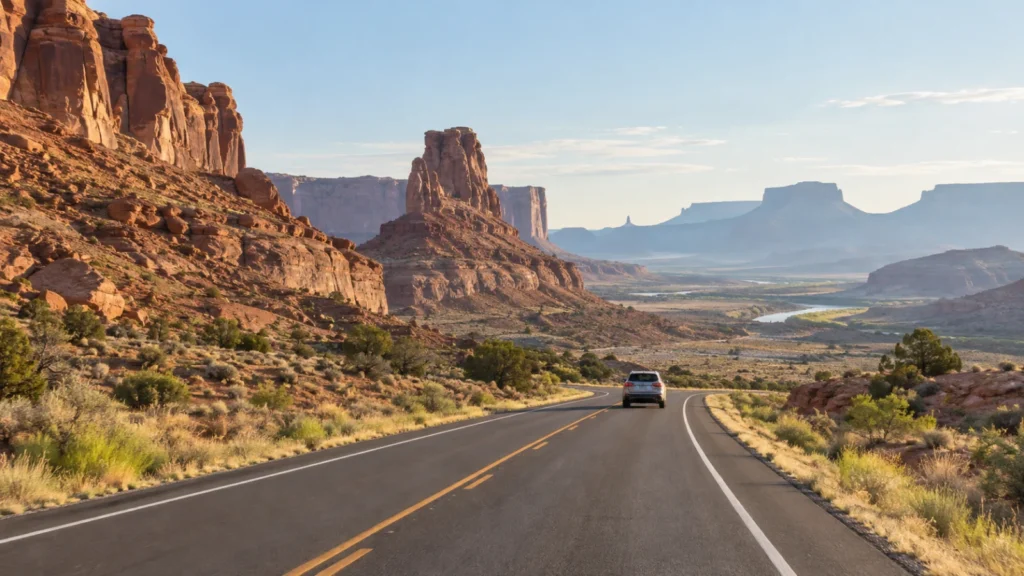
A 7 day Utah road trip can include Zion, Bryce Canyon, Arches, and Canyonlands without turning every day into a race between national parks. The key is choosing a route that limits backtracking and gives you enough time to actually experience each park.
This itinerary starts in Las Vegas, finishes in Salt Lake City, and moves in one direction: Zion → Bryce Canyon → Moab. Using Moab as the final base gives you separate days for Arches and Canyonlands instead of constantly changing hotels.
There is still one significant driving day between Bryce Canyon and Moab. The difference is that the rest of the week leaves enough room to actually experience the parks instead of simply collecting entrances.
Quick Answer
- Route: Las Vegas → Zion → Bryce Canyon → Moab → Salt Lake City.
- National parks: Zion, Bryce Canyon, Arches, and Canyonlands.
- Best bases: Springdale for Zion, Bryce Canyon City or nearby for Bryce, and Moab for Arches and Canyonlands.
- Longest driving day: Bryce Canyon to Moab, roughly 4.5–5 hours before stops.
- Best strategy: fly into Las Vegas and home from Salt Lake City, or reverse the route.
- Biggest mistake: adding Capitol Reef simply because it completes the “Mighty 5.” Seven days become much more rushed when every park has to fit.
- Best seasons: spring and fall generally offer a better balance of temperatures and road-trip conditions, but weather can change quickly at elevation and in the desert.
How This 7 Day Utah Road Trip Works
The route works because it separates Utah’s parks into two natural groups.
Zion and Bryce Canyon are close enough to combine without sacrificing an entire day to transportation. Arches and Canyonlands, meanwhile, can both be explored from Moab.
The inefficient version of this trip constantly changes hotels or forces you to return to Las Vegas after reaching eastern Utah. The better version keeps moving east and finishes in Salt Lake City.
If you are building a larger American driving trip, start with our USA Road Trip Itinerary Planning guide. It explains how to balance driving time, stops, weather, fatigue, and overnight bases before committing to reservations.
7 Day Utah Road Trip Itinerary at a Glance
| Day | Base | Main Plan |
|---|---|---|
| 1 | Springdale | Las Vegas → Zion, easy arrival afternoon |
| 2 | Springdale | Full day in Zion National Park |
| 3 | Bryce Canyon area | Zion morning → Bryce Canyon |
| 4 | Moab | Bryce morning → Moab |
| 5 | Moab | Arches National Park |
| 6 | Moab | Canyonlands — Island in the Sky |
| 7 | — | Moab → Salt Lake City and departure |
Day 1: Las Vegas to Zion National Park
Fly into Las Vegas, pick up your rental car, and drive toward Springdale, the gateway town immediately outside Zion National Park.
The drive is roughly 2.5 hours in normal conditions, but arrival day is not the time to build an aggressive hiking schedule. Flight delays, rental-car lines, food stops, and the time-zone difference between Nevada and Utah can change the afternoon quickly.
Use whatever daylight remains for a relaxed introduction to the area, checking current park conditions before choosing a trail or viewpoint.
Overnight: Springdale.
Day 2: Full Day in Zion
This is your main Zion day, so there is no reason to pack, change hotels, or drive to another park.
During Zion’s shuttle season, private vehicles are not allowed on the Zion Canyon Scenic Drive. The park shuttle itself does not require a ticket or reservation, but schedules change by season, so check the official Zion shuttle schedule before the trip.
Choose activities based on current trail conditions, weather, your group’s ability, and any permit requirements rather than trying to complete a fixed online checklist.
Angels Landing, for example, requires a permit. The bottom-up version of The Narrows does not normally require one, but river flow, flash-flood warnings, temperature, and water conditions can close or materially change the hike.
A good Zion day should leave enough time for the shuttle ride back, dinner in Springdale, and recovery before moving on.
Overnight: Springdale.
Day 3: Zion to Bryce Canyon
You do not need to leave Zion before sunrise just to keep this itinerary alive. Spend the early part of the day on one final Zion activity, then drive toward Bryce Canyon.
Zion and Bryce are close by western-U.S. road-trip standards. The drive is typically around 1.5–2 hours on the direct route, assuming normal road and traffic conditions.
That makes Day 3 an intentional transition rather than a lost travel day.
After checking in near Bryce, use the afternoon or evening for the amphitheater viewpoints or a short hike appropriate to current conditions. Bryce sits at considerably higher elevation than Zion, so temperatures can be very different even on the same trip.
The Bryce Canyon shuttle is seasonal. Do not build the itinerary around it without confirming the current operating dates on the official Bryce Canyon shuttle page.
Overnight: Bryce Canyon City, Tropic, or another nearby base.
Day 4: Bryce Canyon to Moab
This is the longest transfer of the trip.
Use the morning for Bryce Canyon if you want sunrise, a viewpoint, or a short hike, then begin the drive toward Moab. Bryce Canyon to the Moab and Arches area generally takes around 4.5–5 hours before longer meal, scenic, or fuel stops.
Do not turn this into another full national-park day. The objective is to arrive in Moab with enough time to check in, eat, organize the next two days, and rest.
This is also why Capitol Reef is not included in this seven-day version. Adding another national park and another overnight stop would make the itinerary look more complete on paper while making the actual trip less relaxed.
Overnight: Moab.
Day 5: Arches National Park
Moab is only a short drive from Arches, which means Day 5 finally removes long-distance transportation from the schedule.
Give Arches its own day instead of combining it with Canyonlands. That leaves room for parking delays, scenic stops, short hikes, weather, and the possibility that a popular area is temporarily congested.
For 2026, Arches National Park does not require an advance timed-entry reservation. The National Park Service notes that vehicles may still be temporarily diverted when congestion becomes excessive, so arriving with flexibility still matters. Always confirm the latest policy on the official Arches planning page before the trip.
Reservations or permits may still apply to specific activities, campgrounds, or areas even when general park entry does not require timed entry.
Overnight: Moab.
Day 6: Canyonlands — Island in the Sky
Canyonlands is enormous, and trying to “see Canyonlands” in a single day without choosing a district first is a planning mistake.
For this itinerary, use the Island in the Sky district. Its visitor center is roughly 40 minutes from Moab, making it much better suited to a one-day visit than the more distant Needles district, which is around 90 minutes from town.
Island in the Sky is built around broad canyon viewpoints and shorter front-country options that work well after several active days elsewhere in Utah.
General timed-entry reservations are not required for Canyonlands, but permits apply to certain backcountry roads and activities. Check the official Canyonlands permits and reservations page if your plans go beyond normal paved-road sightseeing and front-country hiking.
Overnight: Moab.
Day 7: Moab to Salt Lake City
Finish the road trip by driving from Moab to Salt Lake City. Typical driving time is roughly 3.5–4 hours before stops or traffic.
Do not schedule an early flight unless you are comfortable leaving Moab very early. A later flight—or an additional Salt Lake City night if your schedule allows—creates more buffer for road conditions, rental-car return, airport security, and unexpected delays.
This one-way structure is one of the reasons the itinerary works. Driving back to Las Vegas would add substantial backtracking without adding another park experience.
Why Moab Deserves Three Nights
For a 7 day Utah road trip, using Moab for three nights is one of the easiest ways to reduce hotel changes while giving both Arches and Canyonlands enough time.
Three nights in Moab may look generous on a seven-day itinerary, but it actually removes friction.
- You arrive after the longest driving day and do not need to visit a park immediately.
- Arches gets a full day.
- Canyonlands gets a separate full day.
- You unpack once instead of moving hotels again.
- You have more flexibility if weather or congestion affects one park.
Arches and Canyonlands are close enough to share a base but different enough to deserve separate days.
Why Capitol Reef Is Not in This Itinerary
Capitol Reef is not being skipped because it is less worthwhile. It is being skipped because seven days are limited.
Adding Capitol Reef creates another park, another set of stops, and potentially another lodging decision between Bryce and Moab. You can technically fit Utah’s five national parks into one week, but the trip increasingly becomes about driving to the next entrance.
If seeing all five parks matters more than pace, extend the trip toward 9–10 days. The extra time makes Scenic Byway 12, Capitol Reef, and the transition toward Moab much easier to enjoy.
Best Direction: Las Vegas to Salt Lake City or Reverse?
Either direction works.
Las Vegas → Salt Lake City places Zion near the beginning and finishes with several nights in Moab. Salt Lake City → Las Vegas simply reverses the sequence.
Compare airfare, rental-car rates, one-way drop charges, arrival times, and departure times before deciding.
The important decision is using different arrival and departure airports when the total trip cost makes sense. That prevents several hours of unnecessary driving simply to return a rental car or catch a round-trip flight.
Use our Trip Planning Checklist to compare flights, hotels, rental-car logistics, documents, and booking deadlines before locking the route.
Do You Need an SUV for This Utah Road Trip?
Not for this itinerary as written.
The main highways and front-country national-park roads used here are paved. A normal passenger vehicle is generally sufficient when roads are open and weather is suitable.
That changes if you add backcountry roads or remote routes in Canyonlands or elsewhere. Some roads require high-clearance or four-wheel-drive capability, and permits may apply.
The right rental vehicle is therefore determined by the route you actually plan to drive, not by the fact that Utah contains rugged landscapes.
What to Check Before Each Driving Day
- National Park Service alerts and road conditions.
- Weather at the park, not only at your hotel.
- Fuel availability along longer stretches.
- Sunrise and sunset if you are planning scenic stops.
- Shuttle schedules where applicable.
- Trail, river, wildfire, flash-flood, snow, or ice conditions.
- Permit or reservation requirements for specific activities.
- Offline maps because mobile service can be unreliable.
If you prefer organizing maps, bookings, confirmations, and road-trip stops digitally, see our guide to the best travel planning tools.
Common Utah Road Trip Mistakes
- Trying to see all five national parks in seven days. It is possible, but it changes the trip from exploration to constant movement.
- Changing hotels every night. Moab works well as one base for both Arches and Canyonlands.
- Assuming map time equals travel time. Fuel, meals, scenic stops, parking, construction, and weather all add time.
- Ignoring elevation changes. Bryce Canyon can be much colder than Zion or Moab.
- Building the trip around one famous hike. Permits, weather, trail closures, river conditions, or personal ability can change the plan.
- Assuming park-entry rules never change. Reservation systems and shuttle schedules can change from one year to another.
- Planning the final driving day too tightly. Road conditions and rental-car return should be part of the airport buffer.
If You Want a Different USA Road Trip
Utah works best when national parks and desert landscapes are the priority. If you want a very different one-week route, compare it with our 7-Day Arizona Road Trip, which focuses on Sedona and the Grand Canyon.
For a route built around cities and the Pacific coast instead, see the 7-Day California Itinerary from San Francisco through the Central Coast to Los Angeles.
FAQ
Can you visit Zion, Bryce Canyon, and Moab in 7 days?
Yes. A realistic one-way route can give you two nights near Zion, one night near Bryce Canyon, and three nights in Moab. The main compromise is the longer Bryce-to-Moab driving day.
Can I visit all five Utah national parks in 7 days?
You can, but you will spend more of the week driving and changing locations. For a less rushed trip, either reduce the number of parks or extend the itinerary closer to 9–10 days.
How long is the drive from Zion to Bryce Canyon?
The normal drive is roughly 1.5–2 hours depending on the exact starting point, traffic, road conditions, and stops.
How long is the drive from Bryce Canyon to Moab?
Plan on roughly 4.5–5 hours before significant scenic, food, or fuel stops. It is the longest park-to-base transfer in this seven-day itinerary.
Should I stay in Moab for Arches and Canyonlands?
Yes for this itinerary. Moab is a practical base for Arches and Canyonlands’ Island in the Sky district, allowing you to visit the parks on separate days without changing hotels.
Do I need reservations for Utah national parks?
Requirements vary by park, year, season, and activity. In 2026, Arches does not require a general timed-entry reservation, Zion’s shuttle does not require a ticket or reservation, and Canyonlands does not require timed entry. Specific hikes, campgrounds, backcountry routes, and activities can still require permits or reservations. Always check the official National Park Service pages before traveling.
Conclusion
A 7 day Utah road trip works best when you resist the temptation to include every national park. Zion, Bryce Canyon, Arches, and Canyonlands already create a varied trip with towering canyon walls, hoodoos, natural arches, and enormous desert viewpoints.
The route stays manageable by moving in one direction, limiting hotel changes, and using Moab as the base for the final two parks.
- Fly into Las Vegas and out of Salt Lake City, or reverse the route.
- Give Zion one full day.
- Use Bryce as the transition between southwest Utah and Moab.
- Accept that Bryce → Moab is the one long driving day.
- Give Arches and Canyonlands separate days.
- Check NPS conditions and reservation rules again immediately before traveling.
Last updated: October 19, 2026. National park entry systems, permits, shuttle schedules, trail access, road conditions, weather, wildfire restrictions, river conditions, and rental-car policies can change. Verify current information with the National Park Service and relevant transportation providers before traveling.