
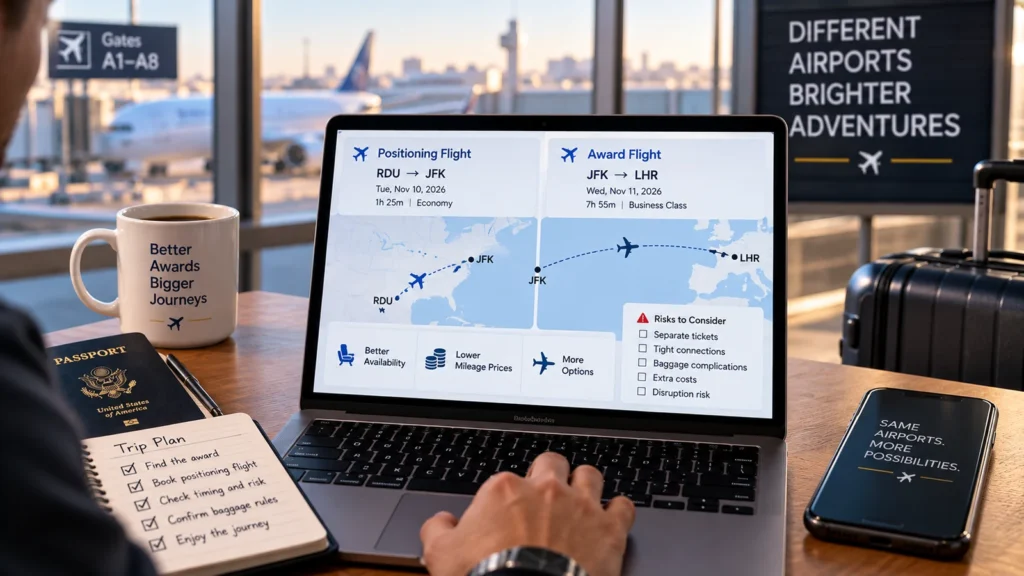
You find the award you want but not from your home airport. Two business-class seats are available from New York, Chicago, or another major gateway, while your local airport shows nothing useful.
This is where positioning flights for award travel can help. Instead of searching only from home to your final destination, you book a separate trip to the airport where the better award begins.
The strategy can unlock better availability, lower mileage prices, or a stronger premium-cabin itinerary. It can also create separate-ticket risk, extra costs, baggage complications, and a missed connection that the long-haul airline may not solve for you. The goal is not simply to find a better award. It is to decide whether reaching that award is worth the added complexity.
Quick Answer
- Best for: flexible travelers who can reach another airport to access substantially better award availability.
- Worth it when: the positioning trip unlocks a rare premium-cabin award, materially reduces the points required, or creates a much better itinerary.
- Not worth it when: the connection is tight, the positioning flight is expensive, the award savings are small, or a disruption would seriously damage the trip.
- What you need: realistic timing, separate-ticket awareness, total-cost comparison, baggage planning, and a backup plan.
- Biggest gotcha: two flights that look connected in your personal itinerary may actually be separate bookings with separate responsibilities.
- Safer default: when the long-haul award is valuable or difficult to replace, arriving at the positioning airport the day before can reduce connection risk.
What is a positioning flight?
A positioning flight is a separate flight used to reach the airport where your primary itinerary begins.
For example, imagine you live near Washington, DC but cannot find a useful business-class award to Europe. You find two seats from New York instead. You could book Washington to New York separately, then start the award itinerary from New York.
The Washington to New York segment is the positioning flight.
Positioning becomes especially useful when award availability is concentrated around major international gateways rather than your home airport.
Why positioning can unlock better award travel
Award searches become more flexible when you stop treating your home airport as the only possible starting point.
| Without positioning | With positioning |
|---|---|
| Search only from your home airport | Search major gateways you can realistically reach |
| Depend on one origin’s award inventory | Compare multiple origin markets |
| May require an undesirable connection | Can start directly from the gateway with the premium award |
| Fewer flight and partner options | Potentially more airlines, routes, cabins, and schedules |
| Simpler trip | More flexibility, but more operational risk |
This matters because award availability is not evenly distributed across every airport, date, airline, or loyalty program. The same basic trip can look very different when you expand the origin. Our guide to why award availability differs between programs explains another layer of that problem.
When a positioning flight can make sense
A rare premium-cabin award becomes available
Positioning can be especially attractive when a difficult business-class award appears from another airport. If the alternative is no usable premium award at all, paying for a short domestic flight may be reasonable.
The mileage difference is substantial
Suppose an itinerary from your home airport requires significantly more miles than starting from a nearby major gateway. A positioning flight can sometimes reduce the total rewards cost enough to justify the extra segment.
The gateway gives you more options
Large international airports often provide more flight frequencies, airlines, nonstop routes, and partner combinations. Even when today’s award is not perfect, monitoring several gateway options can increase your chances of finding something workable.
This is where award seat alerts can be useful: you can monitor realistic alternate origins instead of manually repeating the same searches every day.
When positioning is probably not worth it
- The award saves only a small number of points.
- The positioning ticket is expensive enough to erase the savings.
- You must make a tight same-day connection.
- You are traveling with young children, substantial luggage, or other constraints that make self-connections harder.
- The premium award is easy to replace from your home airport.
- A missed long-haul flight would create a major financial or scheduling problem.
A technically possible positioning itinerary is not automatically a good itinerary. Convenience, recovery options, and the consequences of disruption matter alongside points value.
The biggest risk: separate tickets
Many positioning strategies involve two independent reservations.
Your first ticket may take you from your home airport to the gateway. Your award ticket then begins from that gateway and continues to your destination.
If the positioning flight is delayed or canceled, the second airline may treat you as a passenger who simply did not arrive for its flight. Whether an airline provides assistance can depend on the exact circumstances, ticket rules, and carrier policies, so you should not build the trip around an assumption that the second reservation is automatically protected.
This is fundamentally different from a connection issued together on one protected itinerary.
Same-day positioning vs arriving the day before
| Approach | Advantage | Main risk |
|---|---|---|
| Same-day positioning | Less hotel cost and less total trip time | A delay can threaten the main award |
| Arrive the night before | Much more recovery time before the important flight | Hotel, meals, and another travel day add cost |
| Very early same-day flight | Middle ground when overnight is impractical | Still depends on the first flight operating reliably |
There is no universal safe number of connection hours for separate tickets. Weather, airport size, terminal changes, baggage, immigration, security, flight frequency, and alternative options all matter.
For an award that would be painful or impossible to replace, an overnight buffer is often easier to justify than trying to maximize efficiency with a tight connection.
Do not forget baggage
Separate tickets can make checked baggage more complicated. Do not assume the first airline will check your bag through to the final destination on an unrelated ticket.
You may need to collect luggage, move between terminals, check in again, clear security again, and meet the second airline’s baggage cutoff.
Carry-on-only travel can simplify positioning, but it does not remove the missed-connection risk.
Airport changes can create hidden risk
Some cities have multiple airports. A cheap positioning flight may arrive at a different airport from the one where the award departs.
Before booking, verify:
- arrival airport;
- departure airport;
- real transfer time between airports;
- ground transportation cost;
- traffic or rail constraints;
- whether checked luggage changes the process.
An award that looks excellent on a mileage chart can become unattractive once you add a difficult airport transfer.
How to evaluate a positioning flight step by step
- Find the main award first. Identify a real itinerary worth positioning for rather than speculatively buying a feeder flight.
- Verify the exact award. Confirm cabin, passenger count, points price, taxes, operating airline, and availability with the program that will issue the ticket.
- List realistic gateway options. Compare airports you can reach reasonably by flight, train, or car.
- Price the positioning segment. Include airfare, bags, seat fees, transportation, hotel, meals, and any airport transfer.
- Evaluate disruption risk. Look at schedule margin, later flights, weather exposure, airport complexity, and how difficult the main award would be to replace.
- Choose your buffer. A valuable long-haul award may justify arriving the day before rather than connecting on separate tickets the same day.
- Check cancellation and change rules. Understand both reservations independently.
- Transfer points only when necessary. If the award requires flexible points, verify it before following the process in our points-transfer guide.
- Save both confirmations. Keep flight numbers, record locators, schedules, baggage rules, and backup options accessible during travel.
Example: positioning for a business-class award
Assume a traveler lives near Raleigh and wants to fly to Madrid in business class.
- No acceptable business-class award appears from Raleigh.
- A suitable award appears from New York for 60,000 miles plus $85 in taxes.
- A separate Raleigh to New York flight costs $145.
- An airport hotel near New York costs $180.
- The traveler can arrive the evening before the long-haul flight.
The positioning strategy therefore adds at least $325 before meals, ground transportation, baggage, or other incidental costs.
If the New York award unlocks a premium-cabin trip that would otherwise be unavailable or require dramatically more miles, that additional cost may be reasonable.
If a comparable award from Raleigh costs only slightly more or becomes available regularly, the simpler home-airport itinerary may be the better decision.
This is a hypothetical example. Actual fares, award prices, hotel costs, taxes, and availability vary.
Positioning for business class requires a different risk calculation
The harder an award is to replace, the more conservative the positioning plan should usually become.
A missed short economy award may be inconvenient. Missing a rare long-haul business-class award for two passengers can destroy the reason you positioned in the first place.
If premium cabins are your goal, our guide to booking business class with points covers the broader award-booking workflow.
Positioning outbound and positioning home are different
The outbound positioning flight usually deserves the most conservative buffer because missing the main award can affect the entire trip.
A separate positioning flight after the long-haul return also creates risk, but the consequences may be different. You may prefer a longer buffer, a flexible ticket, or even an overnight depending on how important it is to reach home on schedule.
You can also mix booking styles. The outbound and return do not always need to use the same airport or even the same type of ticket. Our guide to one-way vs round-trip flights explains why separate directions can sometimes provide more flexibility.
Common positioning-flight mistakes
- Booking the positioning flight before the main award is confirmed.
- Assuming separate tickets provide the same disruption protection as one itinerary.
- Using a tight same-day connection because the schedule works perfectly on paper.
- Ignoring checked-bag collection and recheck requirements.
- Missing an airport change hidden inside the itinerary.
- Comparing only the miles saved and ignoring cash costs.
- Choosing an exotic gateway when a simpler nearby alternative produces almost the same value.
- Transferring flexible points before confirming both the award and the positioning plan.
Related reading
- How to Find Award Flight Availability
- Award Seat Alerts: How to Monitor Availability
- Why Award Availability Differs Between Airline Programs
- How to Book Business Class With Points
- Transfer Points to Airlines: When It Makes Sense
FAQ
What is a positioning flight for award travel?
It is a separate flight used to reach the airport where your main award itinerary begins. Travelers use positioning when another airport offers better availability, pricing, routing, or cabin options.
Are positioning flights worth it?
They can be when the positioning segment unlocks a significantly better award. Compare the points saved and itinerary quality with the added airfare, hotel, baggage, transportation, time, and disruption risk.
How much time should I leave between separate tickets?
There is no universal safe connection time. The right buffer depends on airport complexity, baggage, terminals, weather, flight frequency, immigration, security, and how difficult the main ticket would be to replace. For valuable awards, arriving the day before can reduce risk substantially.
Will an airline protect my award if my positioning flight is late?
Do not assume it will. When flights are on separate reservations, protection can depend on the airlines, ticket conditions, and specific disruption. Plan the itinerary so the award does not depend on guaranteed protection from an unrelated ticket.
Should I book the positioning flight before transferring points?
Usually the main award should drive the plan. Confirm the award and understand the transfer requirements before committing to a positioning ticket that only makes sense if the award remains available.
Conclusion
Positioning flights can turn an impossible award search into a workable trip by opening access to additional airports, airlines, routes, and premium-cabin availability.
But the strategy works only when the better award is valuable enough to justify the extra ticket, cost, time, and operational risk.
Find the main award first, calculate the true positioning cost, understand that separate tickets can behave independently, and give important awards enough buffer that one delayed feeder flight does not ruin the trip.
Last updated: October 14, 2026. Airline schedules, award availability, ticket rules, baggage policies, and rebooking practices can change. Verify the rules for every ticket and carrier before travel.