
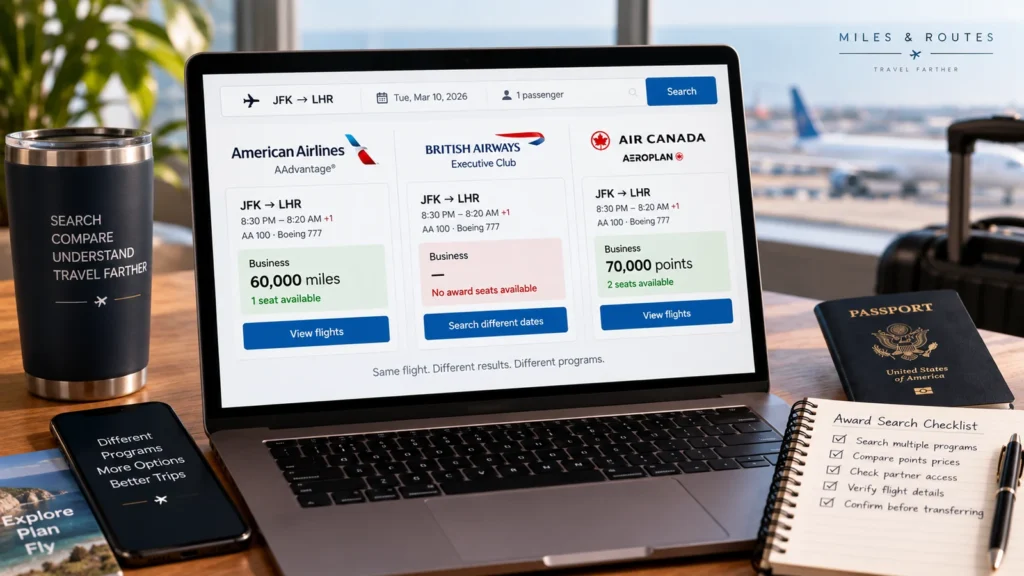
You find the exact flight you want in one loyalty program. Then you search the same date, cabin, and flight number with another program and the award is gone. A third program may show the flight again, but at a completely different points price.
This does not automatically mean one website is broken. Award availability differs between airline programs because the airline operating the flight, the loyalty program issuing the ticket, partner access, pricing rules, passenger count, and even the way an itinerary is constructed can all affect what you see.
Understanding those differences can prevent you from giving up on a good award too early or transferring points toward a seat your program cannot actually book.
Quick Answer
- Same flight does not mean same award inventory: an airline can make different award options available through its own loyalty program and through partners.
- Partner programs can differ: two loyalty programs that both partner with the operating airline do not necessarily display or price the flight the same way.
- Own-program awards can be different: an airline may dynamically price seats or provide member-specific options that are not available to partner programs.
- Search conditions matter: passenger count, cabin, dates, routing, login status, and booking window can change the result.
- Search tools are discovery tools: cached or filtered results may differ from what the booking program shows right now.
- Next step: confirm the exact flight with the loyalty program that will issue the award before transferring points.
The same flight does not have one universal award inventory
Cash availability is relatively easy to understand: an airline has seats for sale at the fares currently offered. Award travel adds another layer because a seat that can be purchased with money does not automatically have to be available through every loyalty program.
The operating airline decides how it makes award travel available. Its own loyalty program may have access to one set of redemption options, while partner programs may receive access to a different subset.
British Airways, for example, explains on its official Reward Flights page that its search presents British Airways availability and can then show partner options. It also notes that the Avios required for partner flights can differ from British Airways-operated flights.
The important lesson is not that one program is always better. It is that the same physical flight can produce different redemption opportunities depending on which loyalty program you ask to issue the ticket.
Operating airline vs booking program
Two roles matter when you search a partner award.
- Operating airline: the airline actually flying the aircraft.
- Booking program: the loyalty program whose points or miles you plan to use to issue the award ticket.
Those can be the same company, but they do not have to be. A partner program may let you book a flight operated by another airline, subject to the inventory, routing, pricing, fees, and rules available through that relationship.
This distinction is one reason our broader guide to finding award availability recommends checking more than one program before concluding that no award exists.
Why award availability differs between airline programs
| Reason | What you may see | What to do |
|---|---|---|
| Different partner access | The operating program shows a flight that one or more partners do not | Search the operating program and other realistic booking partners |
| Dynamic or program-specific pricing | One program offers the flight at a high mileage price while another shows no award | Do not assume expensive availability equals partner availability |
| Member-specific access or pricing | Logged-in users may see a different result or price | Search while signed into the account you would actually use |
| Passenger count | One seat appears, but two or more do not | Always search for the real number of travelers |
| Routing rules | Individual segments exist but the complete itinerary does not appear | Search segment by segment and compare programs |
| Booking-window differences | A flight is visible in one program before another can access it | Check the relevant program’s current booking window |
| Data timing | A tool or program displays a result that another search no longer sees | Re-run the exact search before transferring points |
1. Airlines do not have to share every award with partners
Being alliance partners does not mean two loyalty programs must expose identical award inventory.
An airline can make an award available to members of its own program without necessarily making that same redemption available through every partner. Partner access can also vary by route, cabin, date, or the commercial relationship between the programs.
That is why seeing an award on the operating airline’s site does not prove that your preferred partner program can ticket it.
2. Dynamic pricing can look like extra availability
Some airline programs can offer many or even most of their own flights with miles, but the mileage price may change substantially based on the flight and demand.
A partner program may only have access to the inventory the operating airline has made available for partner redemptions. The result can look confusing: the operating program displays a bookable award at a high mileage price while the partner shows nothing.
That does not necessarily mean the partner search is missing a seat. There may simply be no partner-accessible award inventory for that flight.
3. Your account can affect what you see
Some programs provide account-specific benefits. For example, Aeroplan says eligible primary co-branded credit cardholders will often receive preferred pricing on Air Canada flight rewards.
This is an important reminder when comparing screenshots or search tools: a result seen by another traveler may not be identical to the result shown in your own account.
4. Partner rules can affect the itinerary
A loyalty program does more than display an airline’s seat. It also has to decide whether the itinerary can be issued under its own routing and award rules.
Delta’s official SkyMiles program rules, for example, state that rules for partner award travel may vary and that partner-operated flights can have rules determined by individual carriers.
That helps explain why a connection that appears in one program may not be constructed the same way in another. When that happens, search the individual segments before assuming the underlying seats are unavailable.
5. Passenger count can make two searches look contradictory
A program may have one award seat available but not two. If one website remembers a previous search for one passenger while another is searching for two, the results can appear to disagree even when both are technically correct.
Always compare the same flight using the same date, cabin, and passenger count.
6. Award tools and airline sites can be looking at different moments
Award inventory changes quickly. Third-party search tools may use live searches, cached data, periodically refreshed results, or a combination of methods.
Seats.aero explains in its availability documentation that differences can result from dynamic pricing, expanded award access, timing, and program limitations.
This is why we use award search tools primarily to discover opportunities and then verify the exact result with the program that would issue the ticket.
A practical example
Consider a hypothetical nonstop flight with two business-class seats still available for cash.
| Search | Result |
|---|---|
| Operating airline’s program | Flight available for 95,000 miles per passenger |
| Partner Program A | One business-class award available for 60,000 miles |
| Partner Program B | No business-class award displayed |
These results do not prove that any website is wrong.
The operating airline may be making its own dynamically priced award available. Partner A may have access to one shared award seat. Partner B may have no access to that inventory at all.
If two people are traveling, even Partner A may not solve the trip because only one seat is available through that program.
The example is intentionally hypothetical. Actual availability, points prices, and partner access change by program and flight.
How to check whether the difference is real
- Match the search exactly. Use the same date, flight number, cabin, and passenger count.
- Identify the operating airline. Do not confuse the marketing airline or codeshare flight number with the carrier actually flying the aircraft.
- Search the operating airline’s loyalty program. This tells you what that program makes available to its own members.
- Search the program whose miles you want to use. This is the result that ultimately matters for your booking.
- Try another eligible partner if useful. A second partner can help determine whether the difference is partner-specific.
- Search individual segments. If a connecting itinerary fails, verify whether each flight exists independently.
- Confirm taxes, fees, and cabin. A visible itinerary may still be a poor redemption or contain a mixed-cabin segment.
- Re-run the final search immediately before transferring. Availability can change while you compare programs.
If flexible bank points are involved, review our guide to transferring points to airlines before making an irreversible move.
Real difference vs phantom or stale availability
There is an important distinction between a genuine program difference and a result that cannot actually be booked.
| Situation | What it means |
|---|---|
| Program A can book; Program B cannot | Potentially legitimate difference in program access or rules |
| Search tool shows a seat; booking program does not | Could be cached, filtered, changed, or program-specific data |
| Program shows the award but fails before ticketing | Could indicate stale or phantom availability or an itinerary-rule problem |
| Seat existed earlier and now disappears everywhere | Inventory may simply have changed |
For the last scenario, see our separate guide to why award seats disappear and how to find them again. That is a timing problem; this article focuses on differences between programs.
When award seat alerts can help
If none of the programs you can use currently has the award you need, repeatedly running the same searches may not be the best workflow.
An award seat alert can monitor a realistic route, date range, cabin, or points threshold and give you another chance when availability changes.
Just remember that an alert from one data source still does not guarantee every loyalty program can book that seat. Confirm with the program you plan to use.
Common mistakes
- Assuming alliance partners always have identical award inventory.
- Seeing an award on the operating airline’s site and assuming every partner can book it.
- Comparing searches with different passenger counts.
- Confusing a cash seat with an award seat.
- Assuming a high dynamically priced award must also exist through partners.
- Trusting a cached search result without confirming it in the booking program.
- Transferring flexible points before verifying the exact flight, cabin, passenger count, price, taxes, and fees.
Related reading
- How to Find Award Flight Availability
- Best Award Flight Search Tools
- Award Seat Alerts: How to Monitor Availability
- Why Award Seats Disappear and How to Find Them Again
- Transfer Points to Airlines: When It Makes Sense
FAQ
Why does one airline show an award seat while another does not?
The programs may not have access to the same award inventory. The operating airline can make different redemption options available to its own members and to partner programs, and each booking program also applies its own rules.
Do airline alliance partners share the same award seats?
Not necessarily. Alliance membership makes many partner redemptions possible, but it does not guarantee identical award availability, pricing, routing, or fees across every member program.
If the operating airline shows a seat with miles, can a partner book it?
Not automatically. The seat may be available only through the airline’s own loyalty program or at a program-specific mileage price. Search the partner program directly before transferring points.
Why does an award tool show a seat that the airline does not?
The result may have been cached, availability may have changed since the tool checked it, or the tool may be displaying inventory from a different loyalty program. Always verify with the program that will issue the award.
Should I transfer points when only one program shows the award?
Only after confirming that the program receiving your points can book the exact itinerary for the required number of passengers at an acceptable points price and cash cost. Transfers are commonly difficult or impossible to reverse.
Conclusion
Award availability is not a universal database shared identically by every loyalty program. The same flight can appear differently because the operating airline, partner access, account benefits, passenger count, routing rules, booking windows, and data timing all influence the result.
When two programs disagree, compare the exact flight conditions, search the operating airline and the program you intend to use, and verify the award immediately before transferring points.
The goal is not to make every program agree. It is to identify which program can actually issue the award that works for your trip.
Last updated: October 12, 2026. Award availability, partner access, routing rules, points prices, and program benefits can change. Verify current terms and availability with the loyalty program before transferring or redeeming points.