
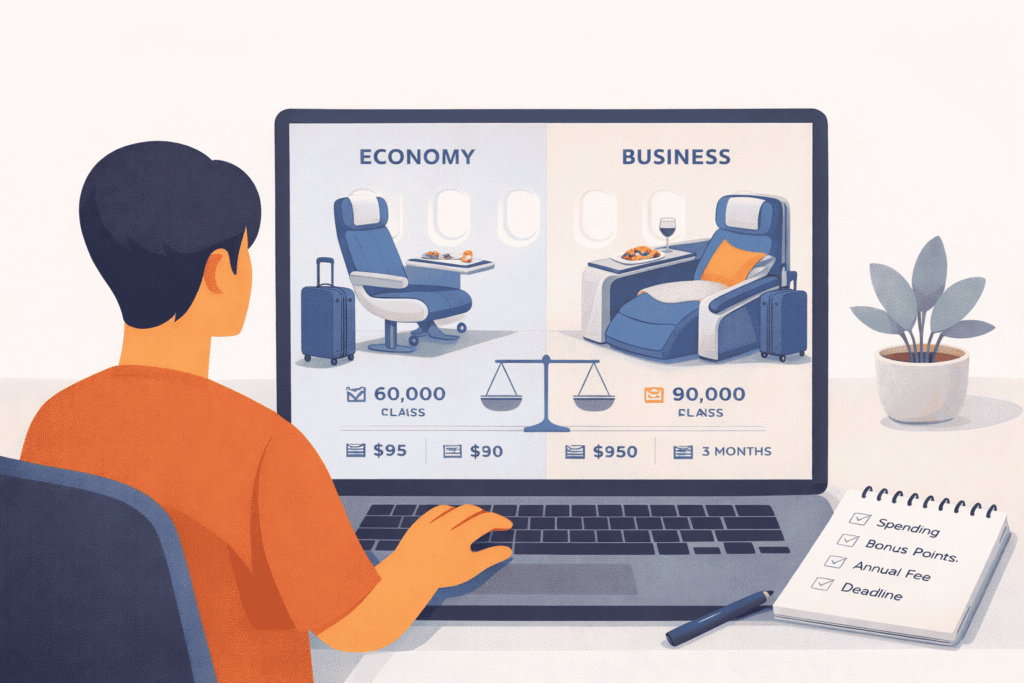
Business class can be worth it, but not simply because the cabin sounds impressive. The useful question is whether the seat, sleep opportunity, schedule, airport experience, and total trip cost solve a real problem for that specific journey. If the realistic alternative is the cabin below it, compare business class vs premium economy on the exact flight before deciding how much the upgrade is worth.
This guide explains what business class can include and how to decide whether paying cash or booking business class with points makes sense for a particular trip.
Quick Answer
- Best for: travelers considering a premium-cabin splurge; people deciding whether points should go toward comfort or more trips; beginners trying to understand what business class actually changes.
- Worth considering when: the flight is long enough for rest or space to matter; the exact seat and schedule improve the trip; or the cash or award cost fits the value you personally place on those benefits.
- Less compelling when: the route is short, the premium cabin offers limited improvement, the price is outside your travel budget, or you would rather use the same cash or points elsewhere.
- What you need: the exact flight, aircraft, seat type, schedule, cash price, award price, fare rules, and a realistic comparison with the alternatives.
- Biggest gotcha: assuming the words “business class” guarantee the same seat, lounge access, service, or ground experience on every airline and route.
- Next step: identify the exact product on your flight, then compare its real benefits with the cash or points required.
What business class can include
Business class is not one standardized product. The seat, airport benefits, meals, baggage allowance, lounge access, and other services can vary by airline, route, aircraft, fare type, and even the specific business-class fare purchased. If first class is also offered, compare business class vs first class before assuming the higher cabin automatically delivers better value.
For example, Delta describes Delta One as offering lie-flat seating, Sky Priority services, dining, and other premium onboard features. However, Delta now sells different Delta One booking options, and lounge access is not identical across them.
Under Delta’s current structure, Delta One Basic includes the onboard Delta One experience but does not include Delta One Lounge or Delta Sky Club access. Eligible Delta One Classic and Extra fares include those airport lounge benefits under the applicable access rules.
American Airlines likewise describes Flagship Business Transcontinental on eligible flights as offering fully lie-flat seating and premium services.
The practical lesson is more useful than either airline example: never value business class from the cabin name alone. Check the exact flight and fare you are considering.
The seat can change the value dramatically
A lie-flat seat on an overnight long-haul flight solves a different problem from a wider recliner on a shorter route. Before booking, compare the actual business class seat, aircraft layout, aisle access, privacy, and sleeping space rather than relying only on the cabin name. If this is your first premium-cabin trip, compare the best business class routes for beginners to see how flight length, schedule, and routing affect the value.
Before deciding what the premium cabin is worth to you, check:
- whether the seat becomes fully flat or only reclines farther than economy
- whether the seat has direct aisle access
- the seating layout and privacy
- the scheduled aircraft
- whether the flight is overnight or daytime
- how many hours you would realistically have available for sleep
Also remember that airlines can substitute aircraft. Recheck important seat and product details as the trip approaches.
When business class can be worth considering
More compelling when…
- the flight is long enough for the extra space or sleep opportunity to matter
- the exact business-class product provides a substantial improvement over the lower cabin
- arriving more rested would materially improve the first day of the trip
- the schedule or airport benefits solve a practical travel problem
- the cash or points required fit your travel priorities
Less compelling when…
- the flight is short and the seat improvement is limited
- the premium cabin on that aircraft is weaker than you expected
- the cash difference would meaningfully reduce the rest of your trip budget
- the award requires points you would rather use for other travel
- you are paying mainly for benefits you will not realistically use
The useful trade-off is comfort versus opportunity cost. Business class can be excellent on the right trip, but the same cash or points can sometimes improve the overall journey more when used elsewhere. If the cabin makes sense but the cash fare feels too high, compare business class deals, route competition, positioning options, and upgrade paths before paying the first premium fare you see.
Step by step: Decide if business class is worth it
- Identify the exact flight. Start with the airline, flight number, aircraft, schedule, and cabin being sold.
- Check the seat. Determine whether it is lie-flat, angled, or a recliner and review the seating layout.
- Check the fare-specific benefits. Do not assume lounge access, baggage, flexibility, or ground services are identical across every business-class fare.
- Compare with the next cabin down. Look at economy or premium economy on the same trip rather than evaluating business class in isolation.
- Calculate the cash difference. Compare the additional amount with other ways that money could improve the trip.
- Check the award option. If seats are available with miles or points, compare the award cost, taxes, fees, and applicable program rules.
- Consider the flight timing. Sleep may carry more weight on some overnight itineraries, while space, privacy, work, or schedule may matter more on a daytime flight.
- Choose according to the trip. The same traveler can reasonably choose business class on one route and economy on another.
Before paying or redeeming, confirm the current cabin product, fare conditions, aircraft, seat details, lounge eligibility, and other included services directly with the airline.
Cash versus points changes the decision
The question “Is business class worth it?” can produce different answers depending on how the ticket is purchased.
When paying cash
Compare the total business-class fare with the lower-cabin fare for the same usable itinerary. The relevant number is usually the additional amount you would pay for the premium cabin, not the business-class price viewed alone.
Then ask what else that difference could fund: another flight, more hotel nights, better trip timing, ground transportation, activities, or simply a lower overall trip cost.
When using points or miles
Compare the award price with both the cash fare and other realistic uses of the same rewards. Availability, taxes, carrier-imposed charges, cancellation rules, and program pricing can all affect the decision.
A premium-cabin redemption can be attractive without being automatically “best.” The right comparison is what those points accomplish for your own travel goals.
Do not overvalue lounge access
Airport lounges can improve a trip, but lounge access should be treated as one component of the ticket rather than the main reason to pay a large premium.
Eligibility can also depend on the airline, route, fare type, operating carrier, lounge, and other access rules. The current Delta One fare structure is a useful example: the onboard cabin may be similar while airport lounge eligibility differs by booking option.
Verify access for the exact ticket rather than assuming every business-class boarding pass opens the same lounges.
Example with assumptions
Example: This scenario illustrates the decision framework. It does not represent a current fare or award price.
- Route: overnight transatlantic flight
- Cabin options: economy, premium economy, and business class
- Business-class seat: confirmed lie-flat product
- Payment options: cash or rewards
- Traveler priority: arrive with a better opportunity to rest before a full first day
Option A: If the business-class award is available at a cost the traveler is comfortable paying in points, the lie-flat seat may meaningfully improve the overnight portion of the trip.
Option B: If the cash premium is large relative to the traveler’s total budget, premium economy or economy may preserve funds for other parts of the trip.
Option C: If the business-class product is only a modest improvement on a shorter itinerary, neither the cash premium nor the additional points may be attractive to that traveler.
Conclusion: The cabin label alone does not determine value. The answer changes with the seat, flight timing, price, award cost, and what the traveler values on that particular journey.
Common mistakes and gotchas
- Assuming every business-class product has a lie-flat seat.
- Comparing cabin names without checking the aircraft or seat.
- Assuming lounge access is automatically included with every business-class fare.
- Ignoring premium economy as an alternative.
- Comparing only the business-class price instead of the incremental cost over another acceptable cabin.
- Using points without considering other realistic uses for them.
- Giving lounge access more value than you would actually receive from it.
- Assuming the scheduled aircraft can never change.
- Equating a premium cabin with guaranteed sleep or a guaranteed better trip.
Related reading
- How to Book Business Class With Points — move from the cabin decision to the mechanics of using rewards for premium travel.
- How to Redeem Miles for Better Value — compare a premium-cabin redemption with other realistic uses of the same rewards.
- How to Find Award Availability — understand why finding a business-class seat with miles can be a separate challenge from deciding whether you want one.
FAQ
Is business class always worth it on a long flight?
No. A longer flight gives you more time to use the seat and service, but the decision still depends on the exact product, price, award cost, schedule, alternatives, and your priorities.
Should I pay cash or use points for business class?
Compare both when possible. Look at the additional cash cost, the award price and fees, your points balance, and other realistic ways you could use either resource.
How do I know if a business-class seat is lie-flat?
Check the airline’s description for the exact flight and scheduled aircraft, along with the seat map and cabin details. Do not rely on the words “business class” alone.
Is business class worth it on a daytime flight?
It can be. Sleep may carry less weight on some daytime flights, but space, privacy, work comfort, schedule, airport services, or simply enjoying the flight may still matter. Compare those benefits with the additional cost.
Does business class always include lounge access?
No. Lounge eligibility varies by airline, route, fare, operating carrier, and lounge rules. Confirm access for the exact ticket before assigning it value.
Conclusion
Business class can be worth it when the actual product solves something that matters on a specific trip: more usable space, a better opportunity to sleep, a useful schedule, greater comfort, or an experience you personally value.
- Judge the exact flight and seat, not the cabin name alone.
- Compare business class with the lower cabins available on the same trip.
- Consider what the additional cash or points could accomplish elsewhere.
- Verify lounge eligibility and other fare-specific benefits rather than assuming they are included.
- Confirm the current aircraft, cabin, fare rules, and service details with the airline before booking.
Last updated: August 11, 2026. Business-class products, aircraft assignments, seats, lounge access, fare types, service details, cash fares, award prices, and program rules can change. Verify the exact flight and ticket conditions before booking.