A 10 day France itinerary has room for Paris, Lyon, and Provence when each destination has a different role. Paris is the long first base. Lyon breaks the rail journey and deserves two nights of its own. Avignon becomes the Provence base, with one city day and one flexible excursion day.
This plan uses ten calendar days and nine nights. It avoids a car in Paris and Lyon, limits the trip to three hotels, and treats Provence as a region that needs more planning than a traditional city break.
Quick Answer
- Nights: Paris 4, Lyon 2, Avignon 3.
- Train moves: Paris to Lyon, then Lyon to Avignon.
- Car: unnecessary for the main route and optional for one rural Provence day.
- Best flight pattern: arrive in Paris and depart from Marseille when the fare and schedule make sense.
- Trip pace: only two hotel changes across nine nights.
- What not to add: Nice, Bordeaux, the Loire Valley, and another overnight Provence village unless you add more days.
10 Day France Itinerary at a Glance
| Day | Sleep in | Main plan | Transport | Planning note |
|---|---|---|---|---|
| 1 | Paris | Arrive and explore near the hotel | Airport transfer | Keep jet lag day light |
| 2 | Paris | Historic core and one major museum | Metro and walking | Group sights geographically |
| 3 | Paris | Neighborhood day and second priority | Metro and walking | Avoid crossing the city repeatedly |
| 4 | Paris | More Paris or one day trip | Local or regional rail | Choose one, not several |
| 5 | Lyon | Train to Lyon and afternoon exploration | Direct high-speed train | Allow for station and hotel time |
| 6 | Lyon | Full Lyon day | Walking and transit | Protect this day from extra trips |
| 7 | Avignon | Train south and explore Avignon | Direct high-speed train | Check TGV versus Centre station |
| 8 | Avignon | Avignon and nearby area | Walking and local transit | No car required |
| 9 | Avignon | One Provence excursion | Train, bus, tour, bike, or rental car | Choose based on season and schedule |
| 10 | Departure | Travel to Marseille airport or onward destination | Rail plus airport transfer | Leave a generous flight margin |
Train durations in this guide are planning ranges based on current schedules, not promises for every date. Search your exact travel day and stations before booking.
Days 1 to 4: Give Paris Enough Time
Day 1 should absorb the airport, hotel check-in, and fatigue. Choose one walkable area near the hotel instead of booking a timed attraction on the opposite side of the city. A delayed flight should not destroy the first day of the itinerary.
Use Days 2 and 3 for Paris itself. The simplest strategy is to group attractions geographically instead of building each day from a list of famous sights scattered across the city.
A major museum, a historic area, a neighborhood, and a relaxed meal can already create a full day without making the itinerary feel empty.
Day 4 should remain flexible. Stay in Paris if there is still more you want to see, or choose one day trip. Versailles, for example, should be treated as a meaningful part of the day rather than something squeezed between several Paris reservations.
The pacing follows the same principle used in our guide to building a Europe itinerary without rushing: fewer bases usually preserve more usable travel time.
Day 5: Paris to Lyon by Train
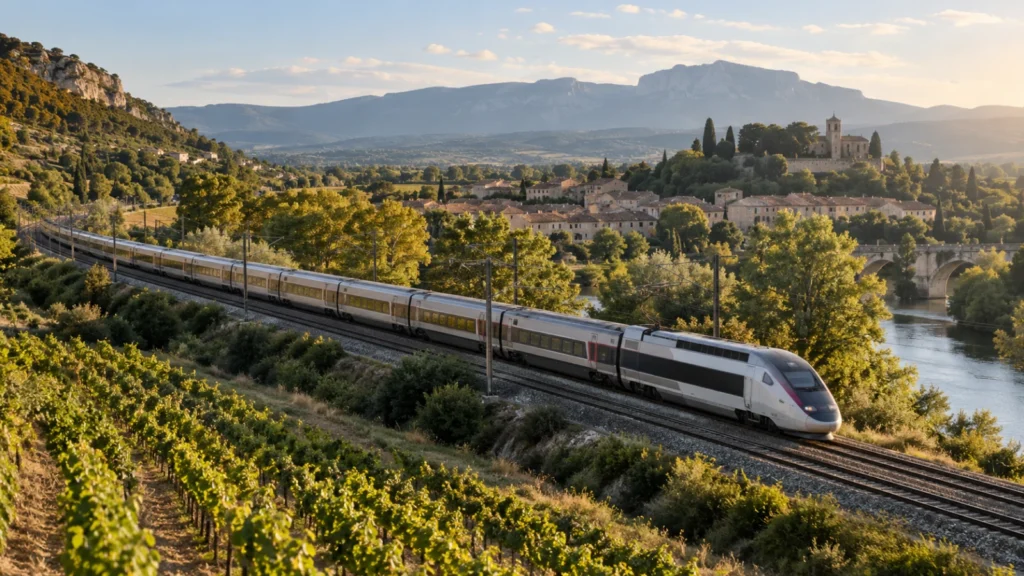
Paris to Lyon is one of the reasons this route works well without a car. Direct high-speed trains regularly complete the journey in around two hours, although the exact service and duration depend on your departure.
Check current options on SNCF Connect before booking.
The train time is not the whole transfer. You still need to check out, reach Paris Gare de Lyon, arrive before departure, leave Lyon Part-Dieu, reach the hotel, and check in. That door-to-door calculation is also the basis of our train vs flight in Europe guide, which compares rail and air beyond the scheduled journey time. When you are ready to buy the rail segments, our guide to how to book train tickets in Europe explains direct operators, aggregators, fare rules and seat reservations.
A reasonably timed morning train gives you a useful afternoon in Lyon without requiring a dawn departure.
Day 6: Give Lyon a Full Day
Lyon earns its place in this itinerary by being more than a train connection between Paris and Provence.
Build one coherent city day around areas such as Vieux Lyon, Fourvière, the Presqu’île, markets, museums, or Lyon’s food culture. You do not need to include all of them.
Avoid adding another day trip simply because a destination looks close on the map. With only two Lyon nights, leaving the city on Day 6 removes its only full day.
Day 7: Lyon to Avignon
The second hotel change is much easier than many travelers expect. Direct high-speed trains from Lyon Part-Dieu to Avignon TGV can take roughly one hour to 1 hour 20 minutes on many services, although schedules vary.
Check the current SNCF Lyon to Avignon schedule for your actual date.
One detail matters: Avignon has two useful train stations.
- Avignon Centre: immediately beside the historic center.
- Avignon TGV: approximately 6 km from the city center and used by many high-speed services.
The stations are connected by regional rail. Read the ticket carefully so that the arrival station does not become a surprise.
After checking in, keep the remainder of Day 7 for Avignon itself rather than immediately collecting a rental car or adding another destination.
Day 8: Explore Avignon Without a Car
Avignon works especially well as the Provence base because the historic center can be explored on foot.
Avignon Tourisme also lists local buses, trams, bikes, and regional transport options, so there is no reason to rent a car simply to explore the city.
Use Day 8 for Avignon itself and, if the pace feels comfortable, a nearby outing that does not require a complex transportation plan.
Day 9: Choose One Provence Experience
This is where a France itinerary becomes different from moving between large European cities.
Provence is a region, not one compact attraction. A beautiful village may have limited public transportation. A vineyard can be far from a rail station. A market may operate only on particular days.
Instead of deciding months in advance that you must visit several specific villages, choose the type of Day 9 that works best for your date.
- Regional rail: best when your chosen town has a practical station and timetable.
- Bus: useful when both the outbound and return schedule work comfortably.
- Small-group tour: useful when you want several rural stops without driving.
- Bike: an option for appropriate routes, weather, and ability.
- One-day rental car: useful when rural villages or vineyards are the priority and the driver is comfortable with local roads and parking.
- Stay in Avignon: completely reasonable when weather or transport makes the planned excursion unattractive.
The flexibility is intentional. A good itinerary should survive weather, schedule changes, and seasonal differences without collapsing. Before choosing exact travel dates, our guide to the best time to visit Europe by region can help you compare how city weather, daylight, crowds, and Mediterranean conditions change through the year.
Day 10: Depart Without Backtracking to Paris
A one-way route through France creates the possibility of flying into Paris and home from Marseille instead of returning all the way north.
That does not mean an open-jaw ticket is automatically better. Compare the airfare with a Paris round trip and include the cost of the train back to Paris, a possible final hotel night, and the time required to reposition.
Our guide to one-way, round-trip, and open-jaw flights explains how to make that comparison.
For an early flight from Marseille, consider spending the final night closer to the airport or adding another trip day. Do not build a tight same-day connection around the first available train.
Do You Need a Car for This France Itinerary?
No, not for the core route.
A car would add parking and traffic complications in Paris and is unnecessary for the Paris–Lyon–Avignon rail sequence. It also creates one-way rental logistics if you pick it up early and return it elsewhere.
The place where a car can add value is Day 9. If your Provence priorities are small rural villages, vineyards, or locations poorly served by public transport, renting a car for a single day may be more practical than keeping one for the entire trip.
Why Three Bases Work Better Than Four or Five
For a 10 day France itinerary, Paris, Lyon, and Avignon create three clearly different experiences without turning the trip into a sequence of hotel checkouts.
- Paris gets enough time to feel like more than an arrival stop.
- Lyon receives one complete day instead of becoming a lunch break between trains.
- Avignon provides a walkable base for Provence.
- Only two days contain intercity hotel moves.
- You still have flexibility for one Paris day trip and one Provence excursion.
Adding Nice, Bordeaux, Strasbourg, the Loire Valley, or another Provence hotel can produce a longer list of destinations, but it usually reduces the depth of the trip.
Common France Itinerary Mistakes
- Adding Nice without adding days. The Côte d’Azur deserves its own time rather than becoming another hotel move.
- Changing hotels throughout Provence. One practical base is often easier for a first trip.
- Booking Avignon TGV while expecting to walk directly into the historic center. Check the station printed on the ticket.
- Treating train duration as total transfer time. Checkout, station access, waiting, arrival, and check-in still matter.
- Renting a car for the entire trip. It adds little value in Paris and central Lyon.
- Choosing a rural excursion before checking the actual date. Transport and opening patterns can vary.
- Automatically returning to Paris for the flight home. Compare the total cost of an open-jaw itinerary first.
FAQ
Is 10 days enough for Paris, Lyon, and Provence?
Yes. Nine nights split between Paris for four nights, Lyon for two, and Avignon for three creates a practical first itinerary. Adding another overnight base makes the trip considerably faster.
How many days should I spend in Paris on a 10 day France itinerary?
Four nights works well for this route. It leaves arrival day plus two full Paris days and one flexible day for either more Paris or a day trip.
Do I need a car in Provence?
Not for Avignon itself. A car can be useful for one rural day, but regional rail, buses, bikes, and organized tours can work for some excursions. Check the exact destination and travel date before deciding.
Should I stay in Avignon or Aix-en-Provence?
Avignon fits this Paris–Lyon rail sequence especially well and has a walkable historic center. Aix-en-Provence may make more sense for a route focused on Marseille, the Luberon, or a different group of day trips.
How long is the train from Paris to Lyon?
Many direct high-speed services take around two hours, although exact times vary by train and station. Check SNCF Connect for your actual date before booking.
Can I fly home from Paris?
Yes. If your international ticket is substantially better as a Paris round trip, return to Paris before the flight rather than relying on a tight same-day rail connection. Compare that cost with departing from Marseille.
Conclusion
A 10 day France itinerary works best when you resist the temptation to cover the entire country. Paris, Lyon, and Avignon create a clean north-to-south route with only two hotel changes.
Four Paris nights leave room for arrival, two strong city days, and one flexible day. Lyon receives a real stay rather than becoming a transfer point. Avignon provides a walkable base plus one flexible day to experience Provence.
- Spend four nights in Paris.
- Take the train to Lyon for two nights.
- Continue by train to Avignon for three nights.
- Keep one Provence day flexible.
- Compare flying home from Marseille with returning to Paris.
Before paying for nonrefundable flights, trains, or hotels, run the whole route through our Trip Planning Checklist.
Last updated: October 23, 2026. Train schedules, station assignments, local transportation, attraction hours, rental-car conditions, and flight options can change. Verify current details with SNCF and relevant official destination and transportation sources before booking.