
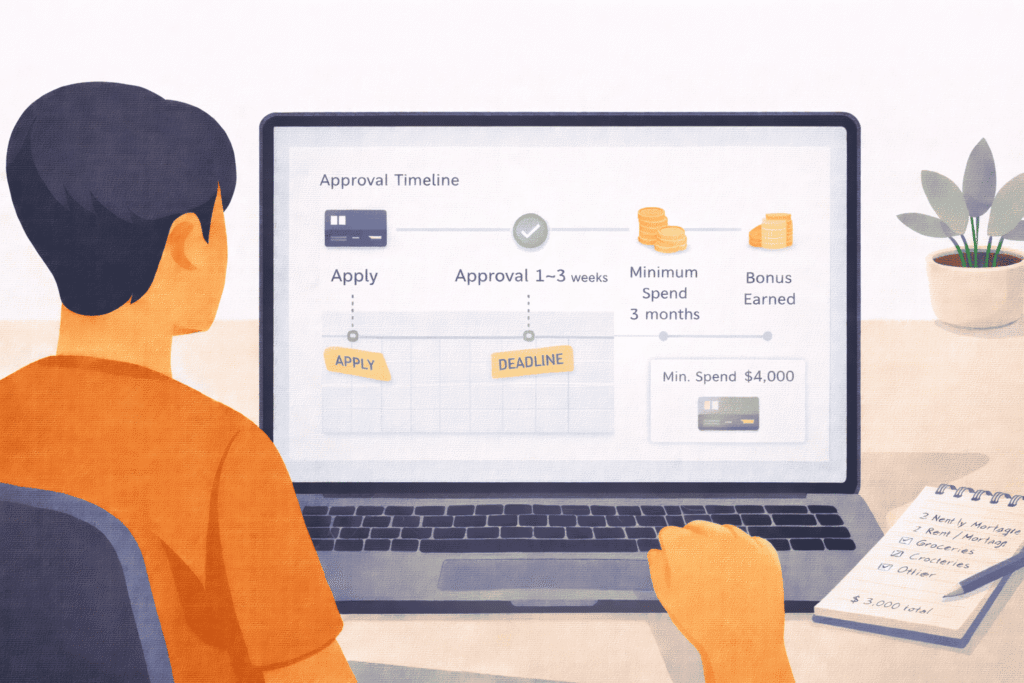
There is no universal rule for how long to wait between credit cards. The right timing depends on your recent credit activity, the card you are considering, your ability to manage another account, and the issuer’s current eligibility requirements.
The useful goal is not to discover a magic number of days between applications. It is to avoid adding new credit faster than your credit profile, spending plan, and account-management habits can reasonably support.
Quick Answer
- No universal waiting period: there is no single number of days or months that guarantees approval.
- Applications matter: applying for a credit card generally involves a hard credit inquiry.
- Recent activity matters: credit scoring models can consider how recently and frequently you have applied for credit.
- Issuer rules matter: check the current eligibility and application terms for the specific card rather than relying on an internet rule.
- Spending matters: do not add another welcome-offer requirement unless it fits spending you already planned.
- Best rule: apply when the card has a clear purpose and you are comfortable with the financial and credit implications of another account.
Why there is no universal waiting period
Credit-card approval decisions involve more than the number of days since your last application. Issuers can consider information in your credit report as well as their own underwriting and eligibility criteria.
The Consumer Financial Protection Bureau explains that when you apply for credit, lenders can perform a hard inquiry and review how recently and frequently you have applied for credit. See the CFPB explanation of credit inquiries.
That is why advice such as “always wait 30 days,” “always wait 90 days,” or “six months guarantees approval” is too simplistic. A particular interval cannot guarantee approval across different issuers, cards, and credit profiles.
What happens when you apply for another card?
A formal credit-card application generally gives the issuer permission to review your credit report. That review typically creates a hard inquiry.
The CFPB states that credit-card issuers can review your full credit report when you apply and that a hard inquiry appears on your report and may affect your credit score. Review the CFPB guidance on credit-card credit checks.
FICO also includes new credit in its scoring framework. It says inquiries remain on credit reports for two years, while FICO Scores consider inquiries from the most recent 12 months. See FICO’s explanation of new credit.
None of that means one application automatically causes a major score change or denial. It means additional applications become another factor to consider rather than a consequence-free step.
Five questions to ask before another application
1. How much recent credit activity do you already have?
Look at recent applications and newly opened accounts before adding another one. Multiple applications in a short period can create multiple hard inquiries and additional new accounts to manage.
Chase’s consumer education materials similarly note that applying for multiple credit cards within a short period can create multiple hard inquiries and that opening several accounts can affect the age of your credit history. See Chase’s credit-card application timing overview.
2. Does the next card have a clear job?
A new application makes more sense when the card solves a defined need: access to a useful rewards program, a feature missing from your current setup, or another benefit you expect to use.
“The offer looks good” is not the same as having a long-term reason for another account.
3. Can you meet any spending requirement naturally?
If the card has a welcome-offer spending requirement, make sure it fits purchases you already expect to make.
Do not create unnecessary spending or carry a balance just to reach a rewards target. The value of a welcome offer can disappear quickly if earning it causes extra purchases or interest charges.
4. Are you comfortable managing another account?
Every additional card can mean another statement, due date, annual-fee review, rewards program, set of benefits, and account to monitor for fraud or unexpected charges.
The ability to manage the new account reliably matters more than maximizing the number of applications you can submit.
5. Have you checked the specific issuer’s current terms?
Do not assume a timing rule found for one issuer applies to another. Eligibility requirements, offer restrictions, application practices, and card availability can change.
Use the issuer’s current application page and offer terms as the final reference for the card you are considering.
Check your credit report before deciding
You do not need another hard inquiry just to review your own credit report.
The CFPB says checking your own credit report does not hurt your credit score and points consumers to AnnualCreditReport.com for free reports from the nationwide credit reporting companies. See the CFPB guidance on checking your credit report.
Reviewing your report can help you confirm which accounts and inquiries are actually being reported instead of relying on memory.
What about preapproval or prequalification?
Some issuers provide preapproval or prequalification tools that can help you explore potential offers before completing a formal application.
Chase explains that its prequalification process typically uses a soft inquiry, which does not affect the credit score, while moving forward with a formal application can trigger a hard inquiry. Prequalification or preapproval does not guarantee final approval. See Chase’s explanation of credit-card prequalification.
Availability and process vary by issuer, so use the current issuer tool rather than assuming every card offers this option.
A practical application-timing framework
- Review your recent applications and accounts. Know what is already on your credit report.
- Finish stabilizing your current setup. Make sure payments, spending targets, and account management are under control.
- Define the next card’s purpose. Be able to explain why the account belongs in your wallet.
- Check the issuer’s current terms. Do not rely on an unofficial universal waiting rule.
- Consider available prequalification tools. Where offered, they may provide information before a formal application.
- Evaluate the spending requirement. Use planned spending rather than creating new purchases for rewards.
- Apply only when another account fits. Timing should follow the financial plan, not an arbitrary countdown.
Example with assumptions
Example: This scenario is illustrative and is not an approval prediction.
- Traveler: recently opened one rewards card.
- Current situation: still working through the first card’s planned welcome-offer spending.
- Next card: would add access to another rewards program.
- Question: apply immediately or wait?
There is no universal rule saying this traveler must wait a specific number of days.
However, if a second card would create overlapping spending requirements, additional account-management work, and another hard inquiry before the first setup is stable, waiting may be the cleaner choice.
If those concerns no longer exist later and the second card still serves a useful purpose, the traveler can evaluate the application based on the issuer’s then-current terms and their current credit situation.
If an application is denied
A denial is not a reason to immediately submit several more applications without understanding what happened.
The CFPB explains that when a lender denies a credit application, federal law generally requires an adverse-action notice that gives the specific reasons for the decision or explains how to request them. See the CFPB guidance on denied credit applications.
Review the stated reason and your credit report before deciding whether another application makes sense.
Common mistakes and gotchas
- Looking for a universal 30-, 60-, or 90-day approval rule.
- Submitting several applications without reviewing recent hard inquiries.
- Assuming a strong credit score guarantees approval.
- Applying because a welcome offer feels urgent rather than because the card has a clear role.
- Taking on overlapping spending requirements that do not fit normal expenses.
- Relying on unofficial issuer rules as if they were guaranteed policy.
- Ignoring another annual fee and account-management workload.
- Immediately applying elsewhere after a denial without reviewing the reason.
- Confusing prequalification or preapproval with guaranteed approval.
Related reading
- Travel Credit Cards 101 — understand rewards, fees, APR, and the basic trade-offs before considering another card.
- How to Choose Your First Travel Rewards Card — start with the role of the card before thinking about application timing.
- Credit Card Welcome Bonuses — compare introductory offers without letting urgency drive the application decision.
FAQ
How long should I wait between credit cards?
There is no universal waiting period that guarantees approval. Consider your recent applications and accounts, current spending obligations, ability to manage another card, and the issuer’s current eligibility terms.
Does applying for a credit card affect my credit score?
A formal credit application generally involves a hard inquiry, which can affect your credit score. The exact impact varies by credit profile and scoring model.
Should I wait until I finish a welcome-offer spending requirement?
There is no universal requirement to do so, but avoiding overlapping spending targets can make account management easier and reduce the temptation to spend more than planned.
Does preapproval guarantee that I will get the card?
No. Preapproval or prequalification can indicate that you meet preliminary criteria, but the issuer can still make a different decision after the formal application and full review.
Should I immediately apply for another card after a denial?
It is usually more useful to understand the denial first. Review the issuer’s adverse-action notice and your credit report before deciding what to do next.
Conclusion
The best answer to how long to wait between credit cards is not a fixed number. Application timing should follow your current credit activity, financial situation, card-management capacity, and the specific issuer’s current terms.
- Do not rely on a universal waiting-period rule.
- Understand that formal applications can create hard inquiries.
- Review your recent credit activity before applying again.
- Use planned spending rather than creating purchases for a welcome offer.
- Make sure every new card has a clear purpose.
- Check current issuer eligibility terms before applying.
Last updated: August 11, 2026. Credit-scoring models, issuer underwriting, application eligibility, welcome offers, card terms, and credit-reporting practices can change. Review current issuer disclosures and your own credit information before applying for credit.