
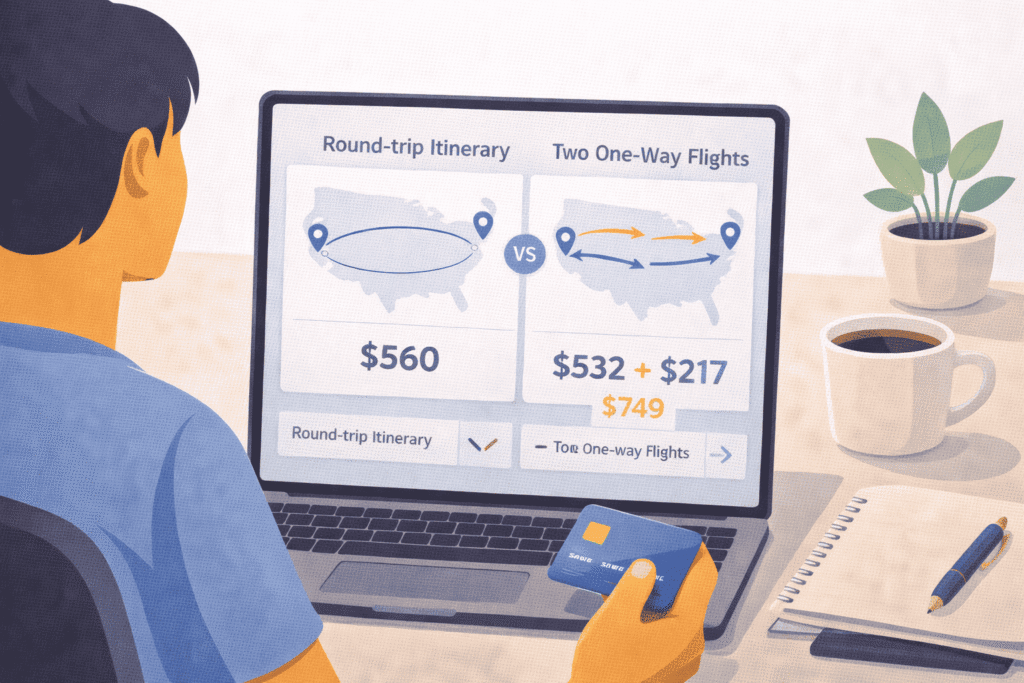
One-way vs round-trip flights is a price question and a risk question. The cheaper booking style depends on route, airline, market, baggage, change rules, and whether your connections are protected on one ticket.
For many U.S. domestic routes, two one-way tickets can price similarly to a round-trip. For some international routes, a round-trip or open-jaw can still price better. Separate tickets can look cheap and become expensive if a delay breaks the trip.
Quick Answer
- Best for: travelers comparing round-trip, two one-way, open-jaw, multi-city, and separate-ticket itineraries.
- Worth it when: a different booking structure lowers total trip cost, reduces backtracking, or adds useful flexibility.
- Not worth it when: a small airfare saving creates expensive baggage differences, inconvenient ground travel, or risky separate-ticket connections.
- What you need: total fares, baggage rules, change policies, connection protection, airport transfers, and onward travel costs.
- Biggest gotcha: separate tickets generally do not provide the same disruption protection as flights booked together on one protected itinerary.
- Next step: run the trip as a round-trip, two one-ways, open jaw, and multi-city search before deciding which structure wins.
Booking styles compared
| Style | Best use | Main risk |
|---|---|---|
| Round-trip | Simple out-and-back travel on one airline or alliance. | Less flexible if you want to return from a different city. |
| Two one-ways | Domestic trips, mixed airlines, or using points one direction and cash the other. | Different change rules, baggage rules, and support channels. |
| Open jaw | Fly into one city and home from another. | Can be harder to price, but often saves backtracking. |
| Multi-city | Complex itineraries on one ticket. | May price higher, but can preserve protected connections. |
| Separate tickets | Positioning to a deal or mixing low-cost carriers. | Misconnect risk sits mostly with you if one ticket is delayed. |
Google Flights can help compare dates, airports, and booking structures; Google’s flight search help explains the search controls. DOT’s buying a ticket guidance is useful for thinking about ticket restrictions, optional services, baggage fees, code-share disclosure, and total price.
A practical comparison
Imagine Chicago to Madrid in May, returning from Lisbon. A Chicago-Madrid round-trip is $720, but you would still need a $110 flight or train back from Lisbon. Two one-ways price at $430 outbound and $520 inbound, or $950 total. A multi-city Chicago-Madrid / Lisbon-Chicago ticket prices at $790.
The round-trip is the lowest airfare, but the multi-city ticket may be the better trip because it avoids backtracking and keeps the long-haul itinerary under one booking structure. If your trip includes several destinations, plan the route to avoid unnecessary backtracking before comparing the final airfare. The same logic can apply to a 7-day California itinerary from San Francisco to Los Angeles, where flying into one city and home from another can eliminate unnecessary backtracking. It can also help with a 7-day Florida itinerary that combines regions such as Miami, the Keys, and Orlando. The two one-ways lose unless the flexibility is worth the extra cost.
Separate-ticket connection risk
A separate ticket is not the same as a protected connection. If your first airline delays you and you miss a second airline’s separate ticket, the second airline may treat you as a no-show. Delta’s missed flights guidance is a useful reminder that missed-flight rules can affect the rest of an itinerary.
Separate tickets can still work when the savings are large, the first flight arrives the night before, or the second ticket is flexible. They are dangerous when the connection is short, international, or on the same day before an expensive long-haul flight.
What to compare before booking
- Total fare, including all mandatory taxes and carrier surcharges.
- Baggage allowance on each ticket and airline.
- Seat and carry-on restrictions if basic economy is involved.
- Change and cancellation rules on every ticket.
- Connection protection and who helps if a delay breaks the itinerary.
- Hotel, rail, or ground-transfer cost created by the booking style.
For award trips, compare this against redemption value math. For cash deals, use cheap flight basics and Google Flights tips.
International fare construction caveat
International pricing can still reward round-trip or open-jaw structures. A one-way to Europe can price competitively on some carriers and oddly high on others. That is why the same search should be run as round-trip, two one-ways, open-jaw, and multi-city before you decide.
Do not forget onward travel. A cheap one-way into one city and a separate return from another may be a good deal, but only if luggage, airport transfers, and schedule protection are still acceptable.
FAQ
Are one-way flights always more expensive internationally?
No, but they can be. Some airlines price one-ways competitively; others still make round-trips or open-jaws more attractive on certain international routes.
Is an open jaw the same as two one-ways?
No. An open jaw can be priced as one itinerary, while two one-ways are separate directional tickets. That difference can affect support, changes, and disruption handling.
When should I use separate tickets?
Use them only when the savings justify the risk and you build in enough time to survive a delay. Overnight positioning is often safer than same-day positioning.
Conclusion
Choose the booking style by total cost and failure risk, not by fare alone. A slightly higher multi-city or open-jaw ticket can beat a cheaper round-trip if it saves time, backtracking, bags, and misconnect exposure. The same calculation shapes this 10-day Brazil itinerary, which starts in Rio and ends in Salvador.
Last updated: August 11, 2026. Fare construction, baggage rules, code-share details, and missed-flight policies vary by airline and booking channel.