
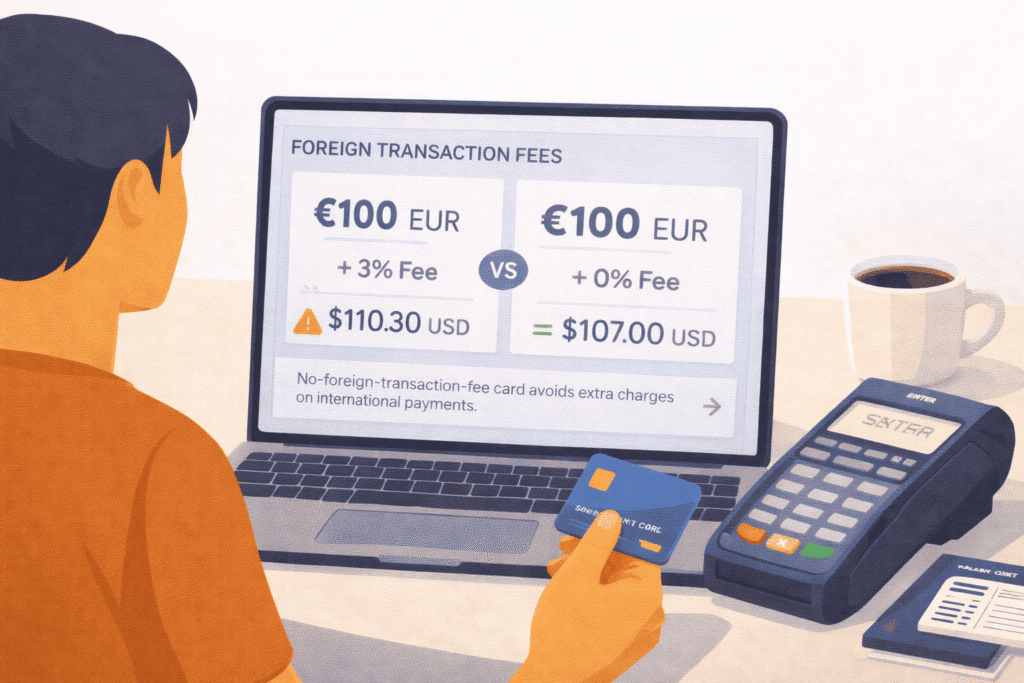
Foreign transaction fees can turn small international purchases into repeated extra charges across hotels, restaurants, transportation, tours, and online bookings.
The important part is understanding when your card may charge the fee, how that differs from currency conversion, and what to check before using a card for an international purchase.
Quick Answer
- What it is: a fee that a card issuer may charge on certain foreign or international transactions.
- Where it can matter: purchases made abroad and, depending on the card terms, transactions involving foreign merchants.
- What to check: your card’s current pricing and fee disclosures rather than assuming every travel card handles foreign purchases the same way.
- Separate issue: dynamic currency conversion, or DCC, is the merchant or ATM offering to convert the transaction into your home currency.
- Biggest gotcha: paying in your home currency through DCC does not automatically protect you from every issuer fee.
- Next step: confirm the foreign transaction fee in your card agreement before relying on that card abroad.
What foreign transaction fees actually are
A foreign transaction fee is an additional charge that may be imposed by the card issuer when a transaction meets the issuer’s definition of a foreign or international transaction.
The exact trigger depends on the card agreement. The Consumer Financial Protection Bureau’s credit-card plan data describes foreign transaction fees as fees that may apply to transactions that take place overseas or with a foreign merchant. See the CFPB credit-card terms data.
That means physical location is not the only factor. A traveler can be at home and still make a purchase involving a foreign merchant. Whether a fee applies depends on the card’s current terms.
Not every card charges a foreign transaction fee. Issuers may offer products with or without one, so the safest source is the specific card agreement or current issuer disclosure. American Express, for example, states that some of its cards have no foreign transaction fee while others may charge one. Review the American Express explanation.
Foreign transaction fee vs currency conversion
A foreign transaction fee and currency conversion are related but different concepts.
- Foreign transaction fee: a fee that may be charged by your card issuer under the card’s terms.
- Currency conversion: the process of converting the transaction from one currency to another.
- Dynamic currency conversion (DCC): an optional service in which a merchant or ATM offers to convert the transaction into your home currency at the point of sale.
Visa explains that DCC can include an exchange rate and additional fees. When DCC is offered, the traveler should be shown the choice between the home currency and the local currency. Read Visa’s explanation of dynamic currency conversion.
Choosing local currency can avoid the merchant’s DCC conversion, but it does not by itself change the foreign transaction fee terms of your card. Those are separate decisions.
When foreign transaction fees matter most
- International travel: repeated hotel, restaurant, transportation, and activity purchases can make a percentage-based fee add up across a trip.
- Large purchases abroad: the larger the transaction, the more noticeable a percentage-based fee can become.
- Foreign online merchants: depending on the card terms, an international merchant can matter even when you make the purchase from home.
- Frequent international spending: a recurring fee becomes more important when foreign transactions are part of your normal spending pattern.
The goal is not to build an entire wallet around one fee. It is to understand whether your existing cards charge it and include that cost when comparing which card makes sense for international purchases.
How to check before you travel
- Open the current card agreement or pricing disclosure. Look specifically for “foreign transaction” or “international transaction” fees.
- Check each card you might use. Do not assume two cards from the same issuer have identical fee structures.
- Separate issuer fees from DCC. A card with no foreign transaction fee can still be presented with an unfavorable merchant currency-conversion option.
- Review the currency before confirming payment. Know whether the terminal or website is charging you in local currency or converting the purchase.
- Check the posted transaction. After the first international purchases, verify how the transaction and any associated fee appear on your account.
Bank of America, for example, tells cardholders to check the specific Credit Card Agreement for the foreign transaction fee that applies to their account. See the current Bank of America fee guidance. The same principle applies generally: use your own issuer’s current disclosure as the source of truth.
Example with assumptions
This example is illustrative and does not represent a universal foreign transaction fee.
- International purchases: $2,000 total during a trip.
- Card A: hypothetical 3% foreign transaction fee.
- Card B: hypothetical 0% foreign transaction fee.
- Other terms: assumed equal only for the purpose of illustrating the fee.
With Card A, a hypothetical 3% fee on $2,000 of qualifying transactions would equal $60. Card B would add no foreign transaction fee under these assumptions.
That does not automatically make Card B the better card overall. Annual fees, rewards, APR, benefits, acceptance, and other card terms can still matter. The example simply isolates the foreign transaction fee so you can see its effect.
Dynamic currency conversion: the separate checkout decision
When paying abroad, a terminal or ATM may offer to show and charge the transaction in your home currency. That is dynamic currency conversion.
The offer may look convenient because you immediately recognize the amount in your own currency, but the conversion uses the DCC provider’s exchange rate and may include additional fees. Visa notes that travelers must be given a choice when DCC is offered. See Visa’s currency-conversion rules.
If you decline DCC and pay in local currency, the card network and issuer can handle the currency conversion according to their normal process. Your card’s own foreign transaction fee, if any, is still governed by the card agreement.
Common mistakes and gotchas
- Assuming every travel card automatically has no foreign transaction fee.
- Assuming the fee can only appear when you are physically outside your home country.
- Confusing the issuer’s foreign transaction fee with dynamic currency conversion.
- Choosing home-currency DCC because the number looks easier to understand without checking the conversion terms.
- Opening a new card for one feature without comparing the card’s broader costs and benefits.
- Failing to check the current card agreement before an international trip.
Related reading
- Travel Credit Cards 101 — understand rewards, fees, and the main trade-offs before comparing individual cards.
- How to Choose Your First Travel Rewards Card — use a broader comparison process instead of choosing a card for one feature alone.
- Trip Planning Checklist — include payments, card access, documents, and other practical details in your pre-trip planning.
FAQ
Do foreign transaction fees only apply overseas?
Not necessarily. Depending on the card agreement, a foreign transaction fee may also apply to a transaction involving a foreign merchant even when you make the purchase from home. Check your specific card terms.
Is dynamic currency conversion the same as a foreign transaction fee?
No. DCC is a merchant or ATM currency-conversion service. A foreign transaction fee is governed by your card issuer’s terms. A transaction can involve one, both, or neither depending on the situation.
Does paying in local currency remove the foreign transaction fee?
Not automatically. Paying in local currency can avoid DCC, but your issuer can still apply a foreign transaction fee if the transaction qualifies under your card agreement.
How do I know whether my card charges a foreign transaction fee?
Check the card’s current pricing disclosure, Card Member Agreement, or issuer account information. Do not rely only on the card name or whether it is marketed for travel.
Conclusion
Foreign transaction fees are easier to manage once you separate the issuer fee from the currency-conversion process.
- Check your card agreement before international spending.
- Do not assume every travel card has the same foreign transaction fee policy.
- Treat DCC as a separate checkout decision from the issuer’s foreign transaction fee.
- Verify the currency and final transaction details before confirming payment.
Last updated: August 11, 2026. Foreign transaction fees, exchange-rate practices, card benefits, and issuer terms can change. Review the current card agreement and payment details before making an international transaction.