
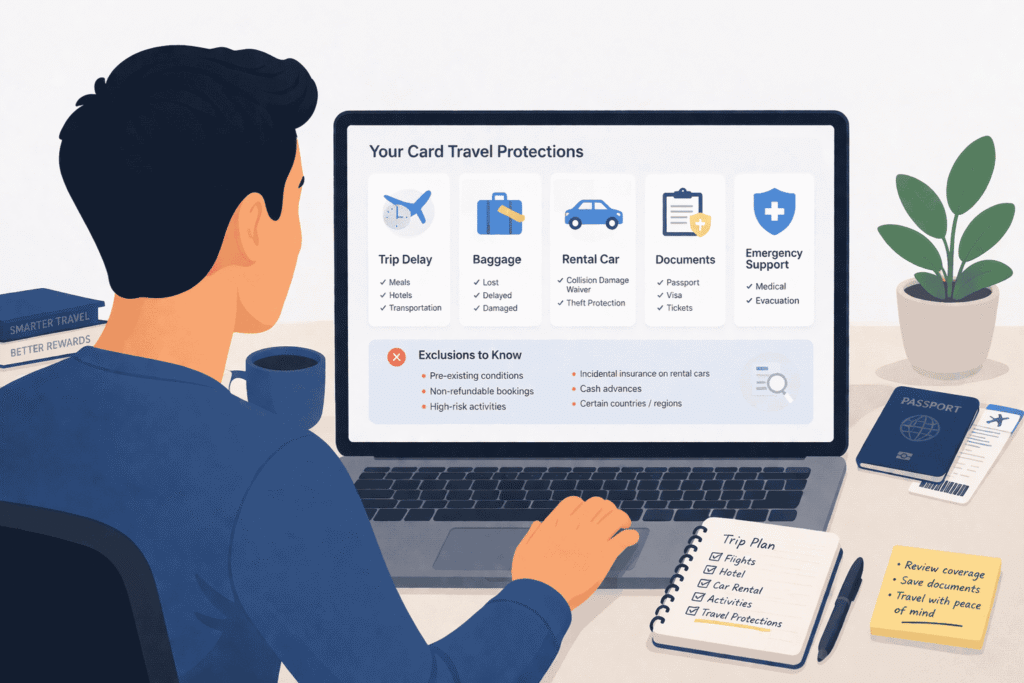
Credit card travel insurance benefits can be useful when a trip goes wrong, but the words “travel protection” do not tell you exactly what is covered.
Coverage varies by card. Payment requirements, covered travelers, eligible losses, exclusions, benefit limits, and claim deadlines can all differ. The safest approach is to treat the specific Guide to Benefits for your card as the source of truth.
Quick Answer
- Possible benefits: depending on the card, protections may include trip delay, trip cancellation or interruption, baggage coverage, rental-car damage coverage, travel accident coverage, or other benefits.
- Do not assume: two cards from the same issuer or network necessarily provide the same protection.
- Payment matters: some benefits require some or all of the eligible travel purchase to be made with the covered card or qualifying rewards.
- Rental-car warning: collision or theft protection does not automatically mean liability, medical, or every type of vehicle damage is covered.
- Medical coverage: never assume your card provides the travel medical or evacuation protection you need without checking the terms.
- Best rule: read the current Guide to Benefits before the trip, not after a problem happens.
What credit card travel insurance benefits can include
There is no universal package of travel insurance that comes with every travel credit card. The available benefits depend on the specific product.
Chase, for example, states that the travel and purchase protections available across its cards vary by product and directs cardholders to the individual Guide to Benefits for coverage, limitations, and claim procedures. See Chase’s current travel-protection guidance.
Depending on the card, categories you may encounter include:
- Trip delay reimbursement: certain eligible expenses after a covered delay.
- Trip cancellation or interruption: certain prepaid or nonrefundable costs when a covered event prevents or interrupts travel.
- Baggage delay: certain essential purchases when covered baggage is delayed long enough to meet the benefit terms.
- Lost or damaged baggage: reimbursement subject to the card’s definitions and limits.
- Rental-car protection: certain theft or collision losses under the conditions of the specific benefit.
- Travel accident benefits: available on some products under defined circumstances.
- Medical or evacuation benefits: available on some products, but they should never be assumed to exist simply because a card is marketed for travel.
The exact names are less important than the terms. A benefit headline is only the starting point.
The Guide to Benefits is the source of truth
Before relying on a card benefit, find the current Guide to Benefits or equivalent coverage document for your exact card.
That document should answer questions such as:
- Who qualifies as a covered traveler?
- What purchases activate the benefit?
- Does the entire trip need to be charged to the card, or only part?
- What events qualify for reimbursement?
- What events are excluded?
- What dollar or time limits apply?
- Is another insurance policy expected to pay first?
- What documents are required?
- How quickly must the claim be reported and completed?
American Express provides a useful example of how specific these rules can become. Its current Trip Delay Insurance page states that the benefit applies to eligible cards and has defined purchase requirements; cardholders are directed to the Guide to Benefits for their specific card. Review the American Express Trip Delay terms.
Payment requirements can determine whether coverage applies
One of the easiest mistakes is assuming that owning an eligible card automatically protects every trip.
Benefits can have specific payment requirements. Depending on the product, the covered trip, fare, rental, or other purchase may need to be charged partly or entirely to the eligible account or paid using qualifying rewards.
Do not generalize one card’s rule to another card. Check the wording for the exact benefit you intend to use before deciding which card will pay for the booking.
Rental-car coverage needs extra attention
Rental-car benefits are an area where the headline can sound broader than the actual protection.
For example, the current Chase Sapphire Reserve Guide to Benefits describes Auto Rental Coverage for certain theft and collision losses. It also states that injuries to people, damage to other property, and personal liability are not covered by that benefit. See the current Chase Sapphire Reserve Guide to Benefits.
That is an example, not a rule for every credit card. Rental-car protections can differ in covered vehicles, rental duration, countries, payment requirements, exclusions, and whether other insurance applies first.
Before declining anything offered by a rental company, understand what your specific card benefit covers and what remains uncovered.
Card protection vs standalone travel insurance
A better question than “Does my card include travel insurance?” is “Which losses would matter on this trip, and which of them does my card actually cover?”
The National Association of Insurance Commissioners explains that travel insurance can include separate categories such as trip cancellation, interruption or delay, travel medical coverage, medical evacuation, baggage protection, and other forms of coverage. Each category can have its own limitations and exclusions. See the NAIC consumer guidance on travel insurance.
A card may provide some of those protections and not others. Even when a category exists, the coverage amount or covered reasons may not match what you need for a particular trip.
When the card may be enough
There is no universal answer, but card benefits may cover the risks you care about when:
- you have reviewed the current benefits for the exact card;
- the important trip costs fall within the benefit limits;
- your payment method satisfies the eligibility rules;
- the covered reasons match the disruptions you are concerned about;
- you understand important exclusions;
- you are comfortable with any gaps that remain.
When the card may not be enough
You may need to compare additional insurance when the trip involves financial or medical risks that the card does not adequately address.
- You need travel medical coverage and the card provides none or too little for your needs.
- You need emergency evacuation protection that is not included or is too limited.
- You have large prepaid and nonrefundable trip costs beyond the card benefit limits.
- You need cancellation protection for circumstances that are excluded from the card benefit.
- You need a type of protection, such as broader cancellation flexibility, that the card does not provide.
- You are taking part in activities that fall outside the card’s coverage terms.
The goal is not to buy duplicate coverage automatically. It is to identify the gaps before deciding whether another policy adds something useful.
A five-step pre-trip check
- Find the current Guide to Benefits. Make sure it is for your exact card, not a similarly named product.
- Identify the risks that matter. Consider prepaid costs, delay exposure, baggage, rental cars, medical needs, and other trip-specific concerns.
- Match each risk to a benefit. Confirm that the relevant coverage actually exists.
- Read the conditions and exclusions. Check payment rules, covered reasons, limits, travelers, deadlines, and documentation requirements.
- Evaluate the gaps. If an important risk remains, compare whether separate coverage is appropriate for that trip.
Claims are about documentation too
Having an eligible benefit does not remove the need to document a covered loss.
Chase tells cardholders that claims generally have specified filing timeframes and may require supporting documentation, with the exact requirements contained in the card’s Guide to Benefits. Review Chase’s current claims guidance.
- Keep booking confirmations.
- Keep receipts for eligible expenses.
- Save proof of payment with the covered account when required.
- Keep carrier or rental-company documentation related to the disruption.
- Record claim reference numbers and communications.
- Follow the deadlines in the current benefit guide.
Example with assumptions
Example: This scenario is illustrative and does not describe a specific card or insurance policy.
- Trip: international vacation with prepaid flights and hotels plus a rental car.
- Card: hypothetical travel card with trip-delay and rental-car collision benefits.
- Traveler concern: delays, rental-car damage, medical emergencies, and losing prepaid trip costs.
The traveler checks the benefit guide and confirms that the payment requirements for the flight and rental were met. The card may provide useful protection for certain covered delays and rental-car collision losses.
But assume the card does not provide the level of travel medical or evacuation coverage the traveler wants. In that case, the card solves only part of the risk picture.
The lesson is not that standalone insurance is always necessary. It is that “my card has travel insurance” is not enough information to make the decision.
Common mistakes and gotchas
- Assuming every travel card includes the same insurance benefits.
- Reading a marketing summary instead of the current Guide to Benefits.
- Booking with a different payment method without checking whether that affects eligibility.
- Assuming every person on the itinerary automatically qualifies as a covered traveler.
- Confusing rental-car collision protection with liability insurance.
- Assuming travel medical or evacuation coverage is included without verifying it.
- Ignoring exclusions because the benefit headline sounds broad.
- Waiting until after a problem occurs to learn the claim deadline.
- Failing to save receipts and other claim documentation.
Related reading
- Travel Credit Cards 101 — understand how card benefits fit into the broader rewards and fee decision.
- How to Choose Your First Travel Rewards Card — compare cards based on the full package instead of one protection benefit.
- Trip Planning Checklist — add insurance, documents, payment methods, and other practical checks to your pre-trip planning.
FAQ
Do credit cards include real travel insurance benefits?
Some cards include insurance benefits, but the available protections and terms vary by card. Check the current Guide to Benefits for your exact product before relying on a benefit.
Do I need to pay for the trip with the card?
It depends on the benefit. Some protections have specific payment requirements, which may involve charging some or all of an eligible purchase to the covered card or using qualifying rewards. Follow the terms for your exact benefit.
Does credit card rental-car insurance include liability?
Do not assume that it does. Some card rental benefits focus on theft or collision damage to the rental vehicle and can exclude personal liability, injuries, or damage to other property. Check the benefit guide before relying on the card.
Is credit card travel insurance enough for an international trip?
It depends on the card and the trip. Compare the benefits you actually have with the risks you want covered, including medical care, evacuation, prepaid costs, baggage, delays, and rental vehicles where relevant.
Does a premium travel card automatically have better insurance?
Do not rely on the card label or annual fee alone. Compare the actual benefit documents, limits, exclusions, and eligibility requirements for the cards you are considering.
Conclusion
Credit card travel insurance benefits can add meaningful protection, but only when the benefit actually covers the loss you care about and you satisfy its conditions.
- Use the exact card’s Guide to Benefits as your source of truth.
- Check payment and traveler eligibility before the trip.
- Read exclusions and limits, not only benefit headlines.
- Do not confuse rental-car damage coverage with full auto insurance.
- Compare important medical, evacuation, cancellation, and other gaps separately.
- Keep the documentation required for a potential claim.
Last updated: August 11, 2026. Credit card insurance benefits, limits, eligibility requirements, exclusions, claim procedures, and card terms can change. Review the current Guide to Benefits for your exact card and the terms of any separate insurance policy before relying on coverage.