
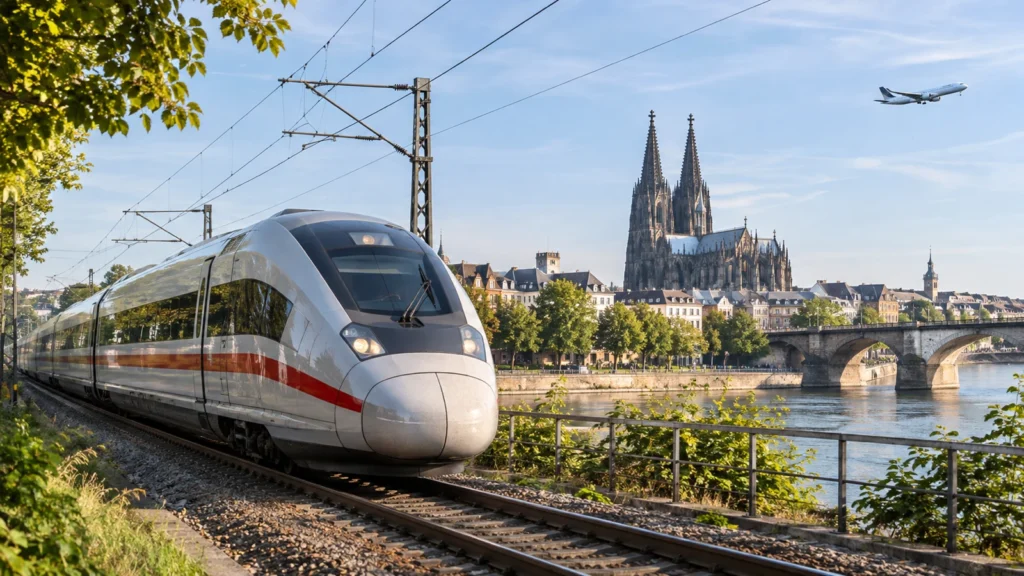
Choosing train vs flight in Europe is not as simple as comparing a two-hour train with a one-hour flight. The useful comparison starts at your hotel door and ends when you reach the next one. Airport transfers, security, bag drop, boarding, station location and arrival time can reverse the result.
Trains often win on connected city-center routes. Flights can be much better across long distances, islands or weak rail corridors. This guide shows how to calculate the real trip instead of repeating a rule such as “always take the train under four hours.”
Quick Answer
- Start with door-to-door time: include every transfer, buffer and arrival step.
- Train advantage: central stations, simpler boarding and fewer baggage fees on many routes.
- Flight advantage: much faster scheduled travel across long distances or poorly connected regions.
- Price the complete trip: add airport transport, bags, seat fees and local transfers.
- Check the exact route: a useful high-speed rail corridor is different from a slow journey with multiple changes.
- Treat time thresholds as heuristics: they help you start the comparison but do not decide it.
Train vs flight in Europe: the decision framework
Compare the same trip on both sides. For rail, include the trip to the station, a sensible arrival buffer, the scheduled journey, any connection and the trip from the arrival station. For air, include the airport transfer, the airline’s check-in or bag-drop deadline, security, boarding, flight time, arrival formalities, baggage claim and transportation into the city.
| Trip factor | Train | Flight | What to compare |
|---|---|---|---|
| Access | Often central | Often outside the city | Hotel-to-platform vs hotel-to-gate time |
| Pre-departure | Usually shorter, but varies | Security, check-in and boarding | Operator and airport requirements |
| Luggage | Often carried onboard | Fare-specific limits and fees | Total cost and handling effort |
| Scheduled time | Slower over long distances | Fast in the air | Door-to-door result |
| Flexibility | Depends on ticket and frequency | Depends on fare and route | Change rules and daily alternatives |
| Family travel | More room to move on many trains | Less onboard time on long routes | Strollers, bags, seats and transfers |
| Disruption | Rail connections can be missed | Airport and flight delays can compound | Protection on one ticket vs separate tickets |
Door-to-door time matters more than scheduled time
A one-hour flight is not a one-hour transfer. If the airport is 45 minutes from the hotel, you arrive well before departure, then spend another hour landing, collecting a bag and reaching the next city, the practical trip may consume most of a day.
A four-hour train can be competitive when you leave from a central station and arrive near the next hotel. It can also be a poor choice if the rail trip needs two changes, uses an outlying station or ends late enough to complicate check-in.
This is the same planning principle used in our 7 to 10 day Europe itinerary: transfer days should be measured by usable destination time, not a single number in a timetable.
City-center stations vs airports
Many major rail stations sit inside the city and connect directly to metro, tram and local rail networks. Airports are frequently farther out, although the difference varies enormously. Amsterdam Schiphol has strong rail access, while some secondary airports marketed with a famous city name require a long bus ride.
Do not assume every station is central either. Confirm the exact departure and arrival stations, not only the city names. A low-cost train or flight can use a less convenient terminal that changes both time and price.
Security, check-in and baggage time
Most continental trains do not use an airport-style security sequence, but exceptions matter. Eurostar services to and from London include ticket, security and border checks. Eurostar currently tells passengers to follow the recommended arrival time on their ticket, with Standard and Plus ticket checks closing 30 minutes before departure at the Amsterdam UK terminal. Check Eurostar’s current station guidance.
Airline and airport requirements vary by carrier, terminal, baggage and destination. A traveler checking a bag or flying outside the Schengen Area may need more time than someone with mobile boarding credentials and carry-on baggage.
When trains usually make more sense
- The route is direct or needs one reliable connection.
- Both stations are convenient for your accommodation.
- The rail schedule protects a useful morning or afternoon.
- Baggage fees or airport transfers make flying less attractive.
- You are connecting cities on a strong high-speed corridor.
- Your group benefits from avoiding another airport process.
Rome, Florence and Venice are a good example of a route where rail geography supports the itinerary. Our 10 day Italy itinerary uses high-speed trains because the cities line up well and the core stations are useful.
When flights usually make more sense
- The cities are far apart and rail requires most of a day or an overnight.
- The route crosses water or a weak rail corridor.
- A nonstop flight has practical airport times and reasonable transfers.
- The train requires several unprotected or tight connections.
- The flight fits an open-jaw itinerary and removes backtracking.
A flight can also be the better choice between distant regions even when rail is possible. The goal is not to maximize train travel; it is to preserve the trip you actually want.
Short, medium and long routes
Short routes
On a direct route of a few hours between central stations, rail often starts with an advantage. That is a planning heuristic, not a universal rule. Poor frequency, expensive last-minute tickets or an airport beside your hotel can change the answer.
Medium routes
This is where door-to-door arithmetic matters most. A train that looks slow can still win after airport time. A well-timed flight can protect half a day when rail needs a connection. Compare both schedules rather than relying on a distance threshold.
Long routes
Flying is often more practical across very long distances. An overnight train can occasionally replace a hotel night and preserve daylight, but only if the route exists, the cabin price works and you can sleep well enough for the following day. It should be evaluated as its own product, not as a generic solution.
High-speed rail changes the calculation
High-speed networks make some city pairs far more competitive by rail than the map suggests. The European Commission’s current plan aims to improve cross-border high-speed connections, but its future journey examples are targets rather than today’s timetable. See the current EU high-speed rail plan.
Always search the exact date with the operating rail company. Construction, seasonal schedules, strikes and connection patterns can change the practical result. Once rail is the better option for your route, our guide to how to book train tickets in Europe explains when to buy direct, when an aggregator can help, and what to check before paying.
Bags and family travel
Rail can reduce baggage fees, but luggage is not effortless. You generally carry it through the station, board with it and store it yourself. Deutsche Bahn currently allows ordinary luggage free of charge and says travelers may bring an additional larger item they can carry themselves, subject to available storage. Check DB’s current luggage guidance.
Families should compare stroller handling, station elevators, seat reservations, transfer time and the amount of gear. A direct flight may be easier than changing trains with several bags. A direct train may be easier than airport security, bag check and a long airport transfer.
Compare the complete cost
- Train or airfare for every traveler.
- Seat reservations and fare restrictions.
- Checked and carry-on baggage charges.
- Airport or station transportation.
- Food during a longer transfer.
- A hotel night if the schedule requires one.
- The value of usable destination time.
Advance rail fares and airline fares both change. Do not hard-code one route as permanently cheaper. Search the same date, passenger count, baggage and flexibility level. The routing process in our multi-city trip planning guide helps expose costs created by backtracking.
Connections and separate-ticket risk
A through ticket can provide rebooking protections that separate tickets do not. If you book an independent flight after a train, or two unrelated rail tickets, a delay on the first segment may leave you responsible for the second.
Build a larger buffer when the onward segment is expensive, infrequent or unprotected. Avoid placing the most fragile connection immediately before an international flight home.
Environmental impact belongs in the comparison
Rail usually has a climate advantage over flying on comparable routes, and the EU’s high-speed rail policy explicitly includes decarbonization. That is a valid factor, but it does not erase accessibility, time, price or route constraints. Treat it as one part of the decision rather than the only answer.
Common mistakes
- Comparing scheduled train time with airborne flight time.
- Assuming every station is central and every airport is remote.
- Ignoring bags, seats and airport transportation.
- Using a rigid “four-hour rule” as a decision.
- Booking separate tickets without a missed-connection plan.
- Choosing the cheapest departure while losing most of a usable day.
- Failing to verify the exact station, terminal and current schedule.
Before locking either option, run the booking through our trip planning checklist.
FAQ
Is train travel always better than flying in Europe?
No. Trains often work well between connected city centers, while flights can be better across long distances, islands or weak rail corridors.
At what train duration should I consider flying?
Use duration only as a prompt to compare. Add airport transfers, check-in, security, baggage and arrival time before deciding.
Are European trains easier with luggage?
They can avoid airline baggage fees, but you usually carry and store bags yourself. Check the operator’s current allowance and station accessibility.
Do European trains require airport-style security?
Most continental services do not, but some routes do. Eurostar to and from London includes security and border controls, so follow the ticket’s arrival guidance.
Should I book a flight and train on separate tickets?
Only when the savings or routing justify the risk. Leave a substantial buffer because a missed independent connection may not be protected.
Conclusion
The right answer to train vs flight in Europe depends on the real route, not a slogan. Build both journeys from door to door, compare complete cost and identify which schedule preserves more useful time.
Choose the train when the corridor, stations and baggage setup make the whole trip easier. Choose the flight when distance, geography or schedule produces a clearly better day. The better option is the one that works after every transfer and buffer is included.
Last updated: November 10, 2026. Rail schedules, airport procedures, baggage rules, fares, border controls and connection policies can change. Verify the current operator and airport information before booking.