
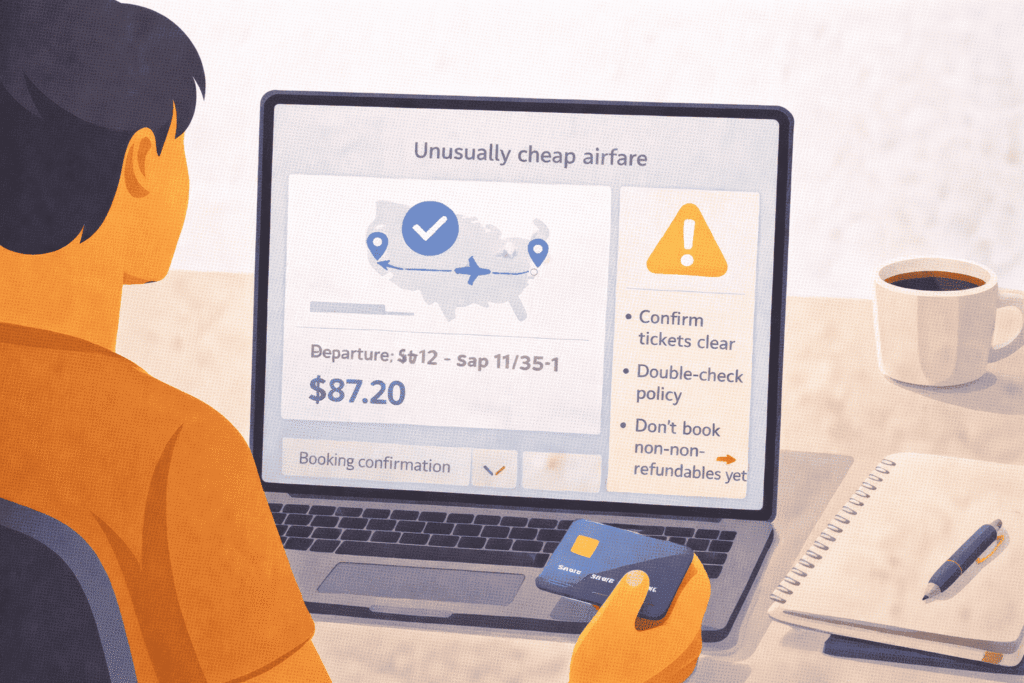
An error fare is an unusually low travel price caused by a mistake, not an ordinary sale. You can book one if the trip makes sense, but treat the reservation as fragile until the ticket is issued and the airline leaves it in place.
A fare sale is intentional. An error fare may come from a currency conversion problem, filed fare mistake, missing surcharge, or technical issue. The airline may honor it, cancel it, or correct it depending on the facts and the rules that apply.
Quick Answer
- Best for: travelers who find an airfare far below normal and want to decide whether it is a sale, an error fare, or simply a strong price.
- Worth it when: the trip already makes sense and you are comfortable with the possibility that the airline may later cancel a mistaken fare.
- Not worth it when: booking the fare would force you to make large nonrefundable hotel, positioning-flight, tour, or other commitments immediately.
- What you need: the booking confirmation, ticket number, payment record, fare details, screenshots, and documentation of any later cancellation.
- Biggest gotcha: a confirmation email does not eliminate the risk that a mistaken fare could be canceled, so downstream spending should remain cautious.
- Next step: book only if the trip works, verify that a ticket was issued, save the records, and delay unnecessary nonrefundable commitments.
Error fare, sale fare, or just a good price?
| Signal | Normal sale | Possible error fare | What to do |
|---|---|---|---|
| Price pattern | Low but plausible against nearby dates. | Far below normal for the cabin, route, or season. | Compare nearby dates and airports before assuming it is a mistake. |
| Promotion trail | Advertised by the airline or tied to a sale window. | Not advertised, appears suddenly, and disappears fast. | Save screenshots, but do not build the whole trip immediately. |
| Ticketing | Confirmation and ticket number usually settle normally. | Confirmation may appear before the ticket is fully issued. | Wait for a ticket number and check the reservation on the airline site. |
| Downstream risk | Lower after ticketing. | Higher until the airline confirms it will stand. | Avoid prepaid hotels, tours, visas, and positioning flights at first. |
What the DOT says about mistaken fares
For U.S.-covered itineraries, the Department of Transportation’s current Buying a Ticket guidance explains the difference between ordinary ticket restrictions, optional services, post-purchase price rules, and fares published by mistake. A legitimate promotion is an intentional sale. An error fare, or mistaken fare, is a computer or filing mistake that may show a ticket far below the intended price.
The key sequence is reservation, ticketing, then reliance. DOT says airlines may cancel reservations booked at a mistaken fare price, but when the rule applies they must reimburse the full ticket price, optional services purchased, and reasonable, actual, verifiable out-of-pocket expenses made in reliance on the ticket purchase. That means a traveler should keep receipts and understand that protection has limits; voluntary cancellation by the traveler is a different situation from cancellation by the airline.
That is different from the general 24-hour cancellation framework and refund rules. DOT’s Buying a Ticket page also explains 24-hour refund-or-hold rules for eligible tickets bought at least seven days before departure, but a passenger voluntarily canceling a trip is not the same as an airline canceling a mistaken fare.
A responsible booking sequence
- Check the route, dates, passenger names, cabin, and full price before payment.
- Book only if you would still be comfortable if the airline later cancels and refunds the ticket.
- Save the airline confirmation, receipt, ticket number, and any cancellation notice.
- Verify the reservation directly with the operating airline.
- Delay nonrefundable hotels, tours, visas, positioning flights, or rail passes until the ticket looks stable.
- If the airline cancels, document any reasonable reliance expenses instead of relying on memory.
How long should you wait?
The 24- to 72-hour wait often mentioned by travelers is practical caution, not a legal guarantee. It gives the airline time to issue or cancel the ticket and gives you time to confirm whether the booking still appears in the airline system. For a simple weekend trip, a shorter pause may be enough. For a complex international trip with visas, separate flights, and prepaid lodging, waiting longer can be rational.
A realistic example
Imagine seeing Chicago to Auckland for $280 round-trip when nearby dates are around $1,250. If the trip is optional, you might book the ticket and wait. If you immediately buy a nonrefundable positioning flight, prepaid hotel, and tour package, your risk has shifted from the airfare to everything around it.
A better order is airfare first, verification second, refundable planning third, and nonrefundable commitments only after the ticket survives the initial uncertainty.
What documentation to keep
Keep the confirmation email, ticket receipt, ticket number, payment record, fare rules shown at purchase, and any cancellation notice. If you later ask for reimbursement of reliance expenses under a rule or policy that applies, the argument is stronger when the expense is documented, reasonable, and connected to the ticket you bought.
Do not treat screenshots as a substitute for current rules. They help establish what you saw, but the airline contract, DOT policy, route, seller, and timing still matter.
Related reading
- Cheap Flights 101 — learn how to compare routes, airports, dates, and total trip cost before deciding whether an unusually low fare is really exceptional.
- Best Time to Book Flights — understand normal airfare timing patterns so you can better distinguish a strong sale from a price that may be unusually low.
- Google Flights Tips — use date grids, price comparisons, and filters to check whether a suspiciously low fare stands out from nearby options.
FAQ
Can an airline cancel an error fare after confirmation?
Sometimes. A confirmation email is useful, but the safer marker is an issued ticket number plus the reservation still appearing correctly on the airline website.
Are reliance expenses always reimbursed?
No. Coverage depends on the rules that apply, the facts, and whether the expenses are reasonable, actual, verifiable, and made in reliance on the ticket. Keep documentation and read the DOT mistaken-fare policy before assuming reimbursement.
Is booking an error fare unethical?
Booking a public fare is not the same as deception. The responsible line is to avoid abuse, false information, and expensive commitments while the booking remains uncertain.
Conclusion
An error fare can be a real opportunity, but it is not a finished trip. Book only when the trip works, confirm ticketing, keep records, and wait before spending nonrefundable money around a fragile reservation.
Last updated: August 11, 2026. Mistaken-fare handling, refund rules, and consumer-protection guidance vary by jurisdiction and itinerary; check the current DOT and airline materials for your booking.