
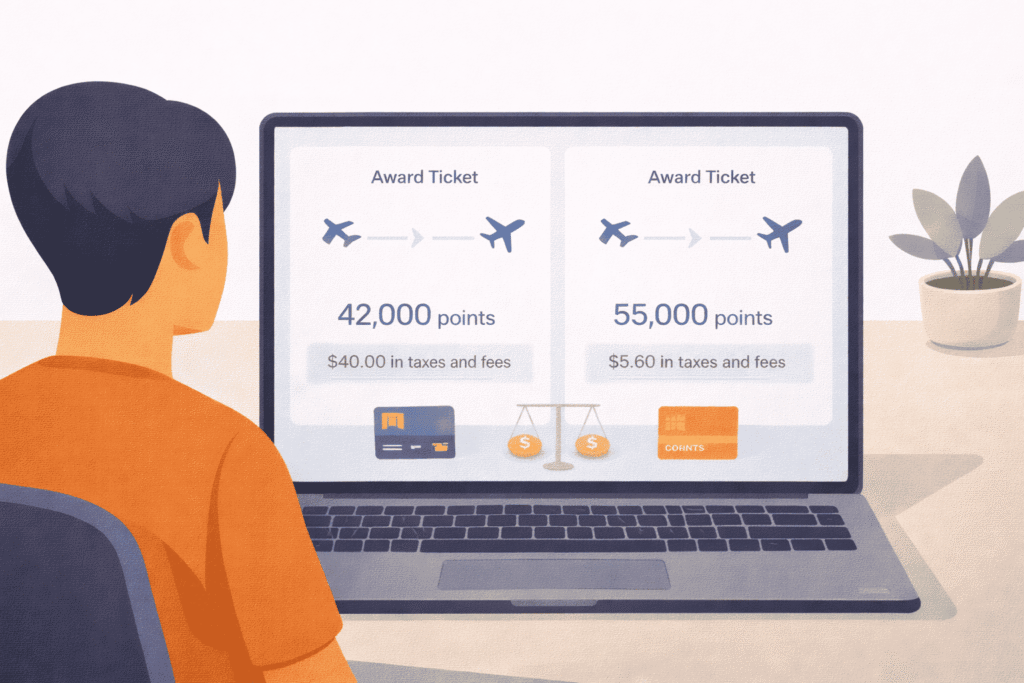
To avoid high surcharges on award tickets, compare the program you book through, the airline operating the flight, the route, and the cash amount due at checkout. The miles price is only half of the award cost.
Quick Answer
- Best for: award travelers comparing redemptions that require a significant cash payment in addition to miles.
- Worth it when: another loyalty program, operating airline, route, or gateway can reduce carrier-imposed charges without requiring unreasonable extra miles.
- Not worth it when: the extra miles needed to avoid a surcharge are worth more to you than the cash savings, or most of the cash cost comes from unavoidable government taxes.
- What you need: the mileage price, taxes, carrier-imposed charges, booking fees, and a comparable cash fare.
- Biggest gotcha: a low mileage price can still be a weak redemption when the required cash component is high.
- Next step: compare the same operating flight through multiple programs and reach the final cash-cost screen before transferring points.
Know the fee labels
| Label | What it usually means | Can you avoid it? |
|---|---|---|
| Government taxes | Charges imposed by governments or authorities. | Usually no, except by changing route, country, or airport. |
| Airport fees | Passenger facility, security, departure, or similar airport charges. | Sometimes by changing airport or connection point. |
| Carrier-imposed surcharge | A fee set by the airline or program, sometimes historically called fuel surcharge. | Often yes by choosing a different program, operating airline, or route. |
| Booking/service fee | A fee for phone, ticket-office, change, or cancellation service. | Often by booking online or choosing another channel. |
DOT has taken the position that mandatory taxes, fees, and carrier surcharges must be included in advertised ticket prices, and DOT separately warns that award travel advertised as free cannot hide required cash charges. See DOT’s guidance on “free” airfares and carrier surcharge disclosure enforcement.
Official examples to compare
| Program or airline | Official fee signal | What it teaches |
|---|---|---|
| Delta SkyMiles | Delta’s Travel with Miles terms say award travel requires at least $11.20 in U.S. government taxes on domestic itineraries and may include foreign government taxes, fees, and carrier-imposed fees internationally. | A low mileage price can still carry a high cash component. |
| AAdvantage | American’s using miles for travel page says eligible taxes and fees can be refunded on canceled award trips, with exceptions for sale-imposed nonrefundable taxes and some already-started trips. | Partner, route, refundability, and trip status matter even when booking through American. |
| British Airways Avios | British Airways says Reward Flights use Avios plus a cash amount covering taxes, fees, and carrier charges, with examples marked current as of May 2026. | Some programs package the cash component differently. |
| Miles & More | Lufthansa’s baggage and other fees page says Miles & More award taxes, fees, carrier charges, international surcharges, and service charges associated with awards are borne by the member and may be charged to the member’s credit card. | Use the checkout page to compare the real cash amount before transferring. |
The route-level takeaway is practical: if New York-London business class prices at fewer miles but several hundred dollars in cash, compare partner programs and nearby routings before transferring. If another program charges more miles but far less cash, it may be the better redemption.
Ways to reduce surcharges
- Price the same operating flight through more than one partner program.
- Try a different operating airline on the same route.
- Avoid routings through airports or countries with high departure taxes when alternatives are reasonable.
- Compare nearby gateways, especially for Europe and transatlantic awards.
- Check cash fares; a cheap paid fare can beat a points booking with high surcharges.
- Do not transfer points until the taxes and fees appear at checkout.
Use transfer points to airlines, award availability search, and redemption value math together before committing.
Miles plus cash comparison
Illustrative example: a traveler might compare Program A at 57,500 miles plus $560 with Program B at 70,000 miles plus $95 and a cash fare at $1,850. Those numbers are hypothetical and exist only to show the decision: the better option depends on how much you value the extra 12,500 miles against the $465 cash difference.
If the cash fare is low, skip the award. If the cash component is high because of carrier-imposed charges, search another partner or route before transferring. If the cash component is mostly government taxes on a route with no reasonable alternative, there may be little to avoid.
FAQ
Are fuel surcharges still about fuel?
Often not in a practical sense. Travelers use “fuel surcharge” colloquially, but many booking paths now label these as carrier-imposed charges or surcharges.
Can a program avoid all surcharges?
Do not assume that. A program may avoid some carrier surcharges on some partners or routes, while taxes and other fees still apply.
Should I always choose the lowest cash amount?
No. Compare miles plus cash. Paying 20,000 extra miles to save $40 is usually weak; paying 20,000 extra miles to save $500 may be reasonable.
Conclusion
High award surcharges are avoidable only when you compare the whole booking: program, operating airline, route, miles, taxes, carrier fees, and cash alternatives.
Last updated: August 11, 2026. Award taxes, carrier-imposed charges, routing rules, and booking fees vary by airline, program, and point of sale.